
If you think of breathing as a feature of Buddhist meditation (see yesterday’s DM) or as a component of Yogic as well as Shamanic traditions, you would be right, of course. It is less common; however, breathing is also found in an important branch of Christian spirituality.

It is only from the 13th century onward that written instructions about breathing are found within Christian monasticism — more specifically, the Greek-speaking portion of it — but scholars tend to assume that the practice is much more ancient and was previously transmitted from one monk to another orally. One monk suggests:
Sit down in a quiet cell, in a corner by yourself, and do what I tell you. Close the door, and withdraw your intellect from everything worthless and transient. Rest your beard on your chest and focus your spiritual gaze, together with the whole of your intellect, upon the center of your belly or your navel. Restrain the drawing-in of breath through your nostrils… and search the place of the heart, where all the powers of the soul reside… You will find there darkness and impenetrable density… [but] later, when you persist and practice this task day and night, you will find, as though miraculously, an unceasing joy.*
The colonial attitude of Western Christians with regard to this ancient Eastern Christian form of meditation might well be at the origin of the derogatory expression “navel-gazing.” It is quite remarkable, instead, that the practice described in this monastic treatise focuses on the third chakra, or rather on the energetic transition from the belly/third chakra (raw energy: anger) to the heart/fourth chakra (raw energy: love).
The monk Nicephorus, born a Roman Catholic in Italy, became an Eastern Orthodox monk in the second half of the 13th century at Mount Athos. He taught the practice of sitting meditation with a special focus on breathing. He explains that the lungs are a wonderful gift from God, which are capable of expanding and contracting like bellows, thus regulating the temperature around the heart and helping the heart itself continue its function, that of maintaining life.
The central point of Nicephorus’ instruction is this: Compel the intellect to descend with your inhaled breath into your heart. This sentence was taken by Western interpreters influenced by the Enlightenment as the epitome of nonsense, but of course, it makes a lot of sense when one is even slightly acquainted with yoga techniques. It’s about concentration and energetic transition. This time, rather than a movement up from the fourth to the third chakra, it’s a movement down, from the sixth to the fourth chakra. The expected result is, again, indescribable delight.
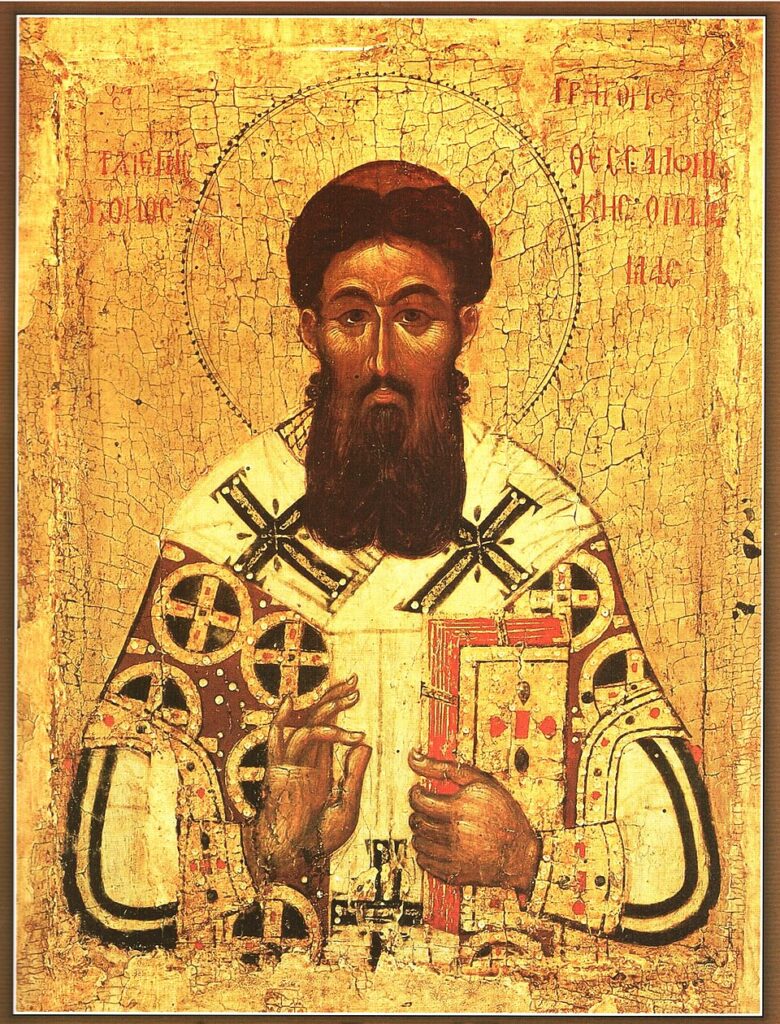
A 14th-century monk, Gregory of Sinai — quite famous in Orthodox Christianity — wrote in the same vein about sitting meditation and the heart. To him, the energy of grace is the power of spiritual fire that fills the heart with joy and gladness, stabilizes, warms, and purifies the soul. To achieve this state, one needs to beseech God in earnest while practicing the prescribed prayers. Gregory even talks about the height of the sitting stool, about nine inches, before repeating instructions about the head bent down, chin resting on the upper edge of the sternum.
Then Gregory repeats Nicephorus’s words: Compel your intellect to descend from your head into your heart. He would like the practitioner to meditate all morning, each and every day. When the person is exhausted, however, he can sit on a cushion instead of a stool. Thank you very much, Gregory, for your kindness!
These and other Christian monks connected their breathing techniques to the “Jesus prayer” — a kind of mantra — as well as to their beliefs about God. Divorcing these techniques from their context would indeed be a way of impoverishing rather than honoring them. At the same time, their remarkable similarities with yoga practices, as well as with the Sufi prayers, which concentrate physically, emotionally, and spiritually on the area of the heart, have long been noticed by scholars and constitute a challenge to all kinds of dualistic spiritualities that keep poisoning our society today.
The connections between this Christian tradition and Creation Spirituality are truly worth some study and dissemination, I think.
* Quotes are from the fourth volume of The Philokalia (Faber and Faber, 1995), pages 72-73, 204-205, 262-264.
Banner Image: Home of the Hesychast Fathers: Mt. Athos, northern Greece. Photo by Dave Proffer, CC BY 2.0. Wikimedia Commons
Queries for Contemplation
Did you know about this tradition of breathing prayer within Christianity? What is your experience with breathing and prayer? How do you connect the two?
Related Readings by Matthew Fox
WHEE! We, wee all the way Home: Toward a Sensual, Prophetic Spirituality.
Sins of the Spirit, Blessing of the Flesh: Transforming Evil in Soul & Society.
The Lotus and The Rose: A Conversation Between Tibetan Buddhism and Mystical Christianity
Charles Burack, ed. Matthew Fox: Essential Writings on Creation Spirituality
A Way to God: Thomas Merton’s Creation Spirituality Journey
One River, Many Wells: Wisdom Springing from Global Faiths
Natural Grace: Dialogues on creation, darkness, and the soul in spirituality and science
Naming the Unnameable: 89 Wonderful and Useful Names for God…Including the Unnameable God

.jpg)
4 thoughts on “Breathing – part 2”
There are striking similarities between the Christian meditation described in this DM and the silent seated meditation taught by Karlfried Graf Dürkheim (1896–1988) and his wife Maria Hippius (1909–2003) in what they called Leibtherapie or Initiatic Therapy at their Todtmoos-Rütte Center in the Black Forest. Graf Dürckheim was both an adept of Meister Eckhart’s spirituality and of oriental spiritual practices like Zen Archery (Kyudo) and Zazen. He defined meditation (from Latin Meditari rather than Meditare) as an on-going journey towards the “middle,” i.e. the Center of Being which he located in the Hara (Hara=Belly in Japanese). He recognized three stages in the practice of meditation: 1- concentration (“withdraw your intellect from everything worthless and transient” in today’s DM); 2- meditation (“search the place of the heart, where all the powers of the soul reside” in today’s DM [sink into the Hara in Dürckheim’s meditation]); and 3- contemplation (“You will find, as though miraculously, an unceasing joy” in today’s DM).
“Hara,” “The Way of Transformation” and “Dialogue on the Path of Initiation” are some of his best-known writings in English translation.
P.S.: Thank you, Gianluigi, for this great quote from Philokalia vol. 4. I explored the source to verify the similarity between the meditation guidance you quoted and Graf Dürckheim’s guidance for meditation, and I found this on page 65 of Philokalia: “It should always be remembered that, when the word ‘heart’ is used in this and many other texts, it signifies not merely the emotions and affections but the spiritual centre of the human person viewed as a unified whole; the heart, as the author states here, is ‘where all the powers of the soul reside’”. Dürckheim, in “Hara: The Vital Center of Man,” locates that center “a little below the navel” and writes: “Intellect, will and emotion, the powers of head, chest and heart with which man as a conscious being has been endowed will prove his undoing if, caught in the net of his concepts, in the brilliance of his achievements and in the web of his entanglements he forgets his anchorage in the weaving and working of the Greater Life. Just as the growth and unfolding of the crown of a tree depends directly on its root-system, so also the vital development of man’s spirit depends on his being true to his roots, that is, to an uninterrupted contact with the primal unity of Life, from which human life also springs.” (Hara, p. 7)
Wouldn’t you agree that, in this context, Heart and Hara are synonyms?
My comment to today’s DM is the same as yesterday’s.
Breating and Spirituality are inseperable. The following poem I dedicated to my brother, James, who died most unexpectedly four years ago.
“Don’t ask me how I am doing.
I am doing extraordinarily well.
I breathe.
I exist with far and distant stars,
The sky and moon.
I am.
“What more can you ask of me?
How much better can we become?
Before us, to my budding mind
Only more and greater ecstasy;
And such, surely, is the meaning of it all.
The end without the beginning without the end.
I am.
“Surely, surely you know this.
How different are you from me?
How much more or less alive is it possible to be?
We either are or we are not,
And we are here now in this moment
Encased in everything.
“I look for separation and find none;
There is no margin, no edge, not even an extremity.
Continual continuousness.
This is how I am.
“Why do you ask how I am?
I am curious to know.
It is a most fascinating question;
Why do we even ask?”
https://www.sedimentofmysoul.com/james