
I very much agree with Matthew Fox’s recent suggestion to apply to the attitude and behavior of people such as Hegseth a new phrase, namely “hysterical masculinity” (see DM July 27).
The notion of “hysteria” — the word itself is derived from the Latin word for uterus — as a tool for the submission of women was created in the 19th century and then widely adopted. Even so, it is relevant to notice that the deranged and unrestrained behavior that the patriarchal men of the 19th and 20th centuries have ascribed to free women is now enacted in reality by their heirs, the patriarchal men of the 21st century, who present very differently than the composed, severe, yet benevolent and condescending medical class of Victorian society.
There is something deep about such a shift. Perhaps patriarchy is aware that it is losing control over society? Is that why its present-day interpreters lose control over themselves? These are people who who are hell-bent on proving their masculinity to the public at all costs. Obviously, then, they are quite insecure about it. Fox defines “hysterical masculinity” as a refuge for men who are afraid of the feminine side of their own souls, including their own powers for empathy and compassion. Hysterical masculinity is busy projecting its fears on the rest of us. Yes!
A quite interesting, even though convoluted, book by Greg Mogenson* makes the point that psychiatrists and psychoanalysts have converged in defining “hysteria” as the unruly spiritual aspect of the human, which Jung instead called “anima” or “soul.” These modern men did not want to have anything to do with what they could not explain with their scientific method. Thus, they marginalized the cries of the soul of their (mostly female) patients, pathologized them, and proceeded in their infinite condescendence to cure their patients’ symptoms — i.e., silence them.
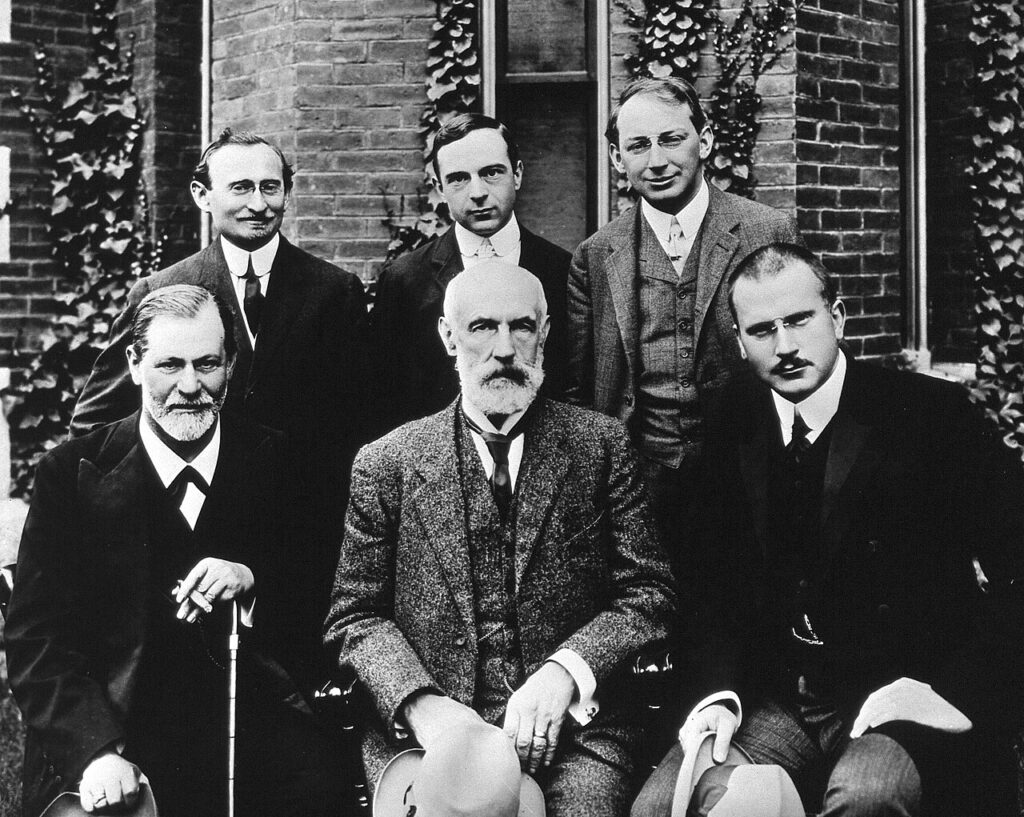
Psychoanalysis, knowingly or unknowingly, says Mogenson, is madly in love with the soul, which it defines as hysteria. Jung stepped out of this morass by acknowledging the soul and her right to disturb the moral certainties of the individual. In his memoirs, he tells the story of discovering a “female voice” within himself, which after his break with Freud was telling him (to his dismay) that his work was not science, but rather art. Jung called this experience “the woman in me.”
One of the most relevant experiences that I had during the recent retreat I led in Sardinia was encountering some men who had already worked at listening to “the woman in them” and took the retreat as a chance to deepen the integration of their female core of empathy and compassion with their external but no less real masculine identity. When some realizations emerged, that is, the anima of the man started speaking freely, one could witness, for example, uncontrollable sobbing or incoherent speech.
Behaviors that 19th-century psychiatrists would have dubbed as hysterical, are in fact the language of the soul. The men who came out of that retreat were capable of deep hugs, unafraid of the gender/sexual identities of the people they hugged. Feelings could flow easily. Yes, feeling did interrupt rationality, but interruption is not negation. The fear of total loss of control because one can feel — what? the pain of another, or one’s own pain, or the joy present in the cosmos — is precisely only a fear, not a reality.

Reconciled men are the polar opposite of hysterical men. The two groups, in fact, share the same core softness, the same need to break out of the rigid roles assigned to them since birth, the same desire to be caressed and caress and hug other humans, and pets, and trees. Yet those who staunchly refuse to listen to their core voice end up exhibiting uncontrolled behaviors not for a moment, but long term. And their uncontrolled behavior is all the more destructive as they — as men in a patriarchal society — are very difficult to stop.
Hegseth, Trump, Musk, and their ilk all need a good mental breakdown. Unfortunately, they are so “hell-bent” on repressing and despising their soft inner core, that when that happens it is likely to be severe and potentially untreatable. If I suffered from a God complex I would invite them to my next retreat in Italy, which will be focused precisely on these matters (June 2027). I am happy, instead, to realize that I am able to work at the intersection of politics and spirituality, catching not just the fashion of the time, but the core issues of our era.
Greg Mogenson, The Dove in the Consulting Room
- Banner image: The toxic masculinity of Hegseth and Trump. “Zombies: They are good at destroying things, but not much else.” PhotoArt by Folsom Natural on Flickr
Queries for Contemplation
What is your own relationship with hysteria?
Related Reading by Matthew Fox
The Hidden Spirituality of Men: Ten Metaphors to Awaken the Sacred Masculine
Trump & The MAGA Movement as Anti-Christ
Charles Burack, ed., Matthew Fox: Essential Writings on Creation Spirituality
Sins of the Spirit, Blessings of the Flesh: Transforming Evil in Soul and Society

7 thoughts on “Hysteria and Men”
Almost 90 million Americans did not vote in 2024, the rest is hystery.
More seriously, a very instructive paper titled Women and Hysteria in the History of Mental Health is available on-line at the NIH National Library of Medicine [ https://pmc.ncbi.nlm.nih.gov/articles/PMC3480686/ ]. The last section focuses on “Sardinian modern cases” and tells the horrible story of Giovanna M.: “diagnosed” with madness at the age of 10, she was moved to the basement of Cagliari’s Sant’Antonio Hospital. She describes it, “as dark as a tomb, the only place on the island where the mad… or the insane… or the maniacs… or the idiots – as we were called- were locked up. We were 50 people in chains, in the smell of our own excrement, with rats gnawing at our ulcers…”
Eighty years after her diagnosis, these words from the hospital archives are attributed to her: “And you’d better believe it: I was 90 years old. Fate, which takes away healthy, free, young people, never pardoned me once. It has let me live all this time, quite lucid, but closed up in here … since I was ten years old …. eighty years in psychiatric hospital for a headache.”
Giovanna, your scream has been heard, forgive them, for they do not know what they are doing.
Having studied Jung’s Analytical Psychology and having practiced psychotherapy before my retirement, I found the enclosed Ted talk on the history of ‘female hysteria’ very interesting and accurate. The human history of female oppression by male patriarchy is very sad and symptomatic of the spiritually unbalanced and destructive history of not valuing and spiritually integrating the Divine Feminine in our human evolution. Even though there have been improvements and progress in recognizing and valuing women’s rights since the twentieth century in Western society, toxic, racist, and misogynistic patriarchy still dangerously exists in many parts of the world. I also agree with Matthew Fox’s analysis of “hysterical masculinity” (DM of July 27) in the Trump administration and his MAGA followers and enablers in the US. Fortunately, the Divine Feminine Spirit of Love~Wisdom~Truth~ Justice~Peace~Strength~Compassion… Is still very much Alive and Present within and among Us to guide and strengthen Our personal and collective human spiritual evolution within Our Sacred Mother Earth and Cosmos, including All physical/nonphysical spiritual dimensions/beings….
So as a 60 year old gay man I’ve been wrangling with hysterical masculinity my whole life. But, I feel like things are changing! I recently joined a men’s group and despite a fair amount of anxiety I went to my second meeting and disclosed that I am actually afraid of men, and always have been. Straight men have treated me poorly, because I have never conformed to their rigid behavior rules. Gay men are even WORSE generally. Some have been very cruel to me over the years for various reasons.
But in spite of this long history, this particular men’s group of half a dozen strangers sent me such a strong wave of unconditional love after my disclosure that I nearly burst into tears! They accepted me — just as I am.
It’s one small group, and it’s in Massachusetts so there’s that (liberal bubble), but I find it hopeful nonetheless. It’s difficult to see the signal through the noise at times, but things ARE changing for the better!
(Also 5 points for The Cranberries reference!)
I would like information about your 2027 retreat. Thank you for your meaningful reflections.
Janice
Thank you, Janice. Coming soon.
One historical conception of hysteria was connected to the idea of the “wandering womb,” in which the uterus was believed to move through the body, affecting various organs and producing symptoms and abnormalities. What this sounds like to me is a woman’s repressed soul suffocating inside a rigid system—a soul’s cry for help, expressed throughout the body because it had no other way to speak.
I recognize in myself the tendency to retreat into my own “hysteria” of thought, control, and rationality when something feels too vulnerable or overwhelming. I can manage an emotion long before I allow myself to feel it. I have learned to analyze and contain my inner experience rather than letting it move through me and be authentically expressed.
Today, we may be seeing the same spiritual pathology as “hysterical masculinity.” Men carry the unaddressed spiritual wound of the Fisher King. They have closed their hearts and rejected the Grail/womb of their inner feminine energy—the intuitive, receptive, creative, and generative force within them. Starved of genuine spiritual connection, this rejected force has nowhere to go. It becomes their own “wandering womb,” a displaced creative and intuitive force erupting into the world as a volatile cry for control. Like the wounded Fisher King, the wound does not remain contained within the individual; it creates a wasteland around him.
“Hysterical masculinity,” is a perfect term to describe MAGA society, especially some of its leaders, e.g., Pete Hegseth and Stephen Miller. The term brings their issues to light. I’m going to use it. As you say, “These are people who are hell-bent on proving their masculinity to the public at all costs. Obviously, then, [these men] are quite insecure about it.” I like taking a term attributed to women in the Victorian world and using it to help us understand what’s going on with these men. If we can have compassion for women diagnosed with hysteria in the 19th Century, we might be able to have some compassion for these men. Things have changed very fast and they are terrified.
Meanwhile, a shout out to a stage narrative involving the history of “hysteria,” catch the next production of Sarah Ruhl’s play “In the Next Room, or The Vibrator Play.” It’s hilarious and touching.