
Hildegard of Bingen (1098 – 1179) is a kind of patron saint of Creation Spirituality for a number of good reasons, but essentially because of her notion of viriditas (greenness).
As the vital energy animating all creatures, viriditas can be lost as well as acquired. People can enjoy it as the supreme gift of God, which is found, however, within the creatures themselves. It is not perceived as coming from above or from outside the physical bodies of creatures. This fact, in contemporary theological terms, bespeaks of “immanence” and “panentheism.”
Looking at the world as a place bursting with viriditas is very much in tune with the via positiva, which constitutes the core teaching of Creation Spirituality. Since the very beginning of his career, Matthew Fox fought against a spirituality which privileged redemption, suffering, and the cross and argued for a spirituality of creation, joy, and the fullness of life. Thus, Hildegard, who exclaimed: God lives in every created thing… All creation is gifted with the ecstasy of God’s light.
Matthew himself has spoken and written at length about Hildegard, emphasizing several aspects of her theology, such as her keen ability at naming and describing evil. He considers her a prophet on behalf of the Earth, as well as a proto-feminist. He acknowledges her amazing versatility in so many fields, including painting and music composition.
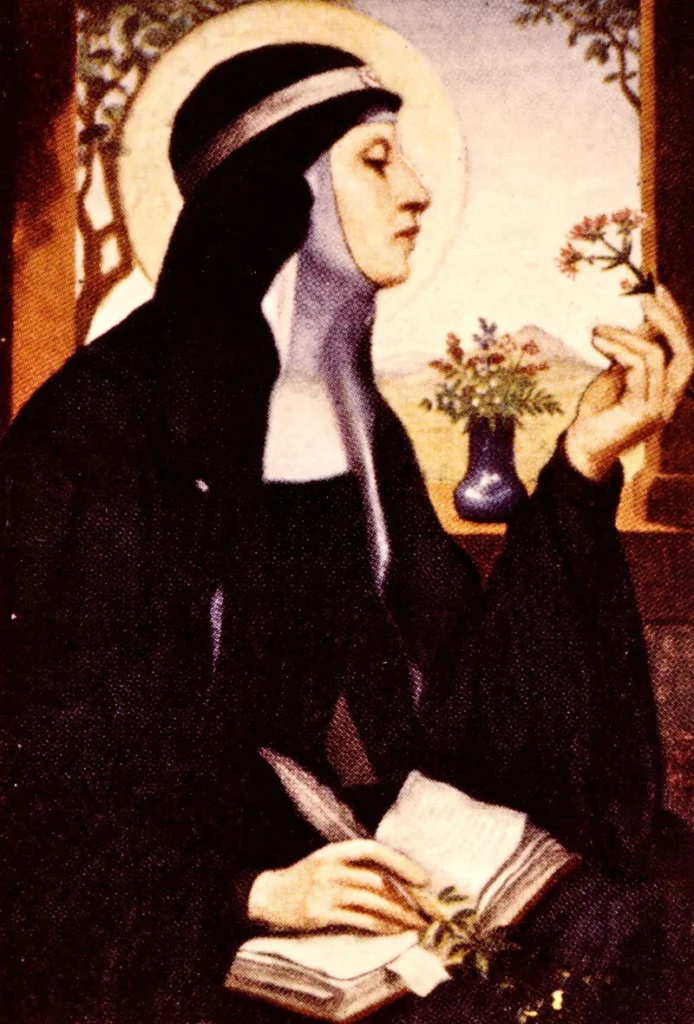
Hildegard’s versatility includes her work as a healer through the virtues of plants. But she was not just a herbalist. She had also a quite developed theory of human nature, a specific understanding of human characters, and a quite precise idea of what an “illness” is really about. Several notions that have recently returned to the Western consciousness, such as the importance of balance and psychosomatic interactions, were a common patrimony of medieval medicine; yet some of Hildegard’s ideas in this field are uniquely hers, and they are truly worthy to know.
Hildegard wrote down systematically most of her ideas about the causes and the cures for illnesses in a book which she titled Liber subtilitatum diversarum naturarum creaturarum. Her book was copied in subsequent centuries, resulting in two different volumes which received different titles, but the original title is the most explanatory: natural creatures have certain subtle qualities (subtilitas) which can be studied and known, and therefore employed for the curing of illnesses in people.
It is remarkable that an abbess who was living in her monastery in the countryside, and was quite busy governing it, cared for the study of nature in such a detailed way that even surpassed the curiosity for the natural world that was developing in the context of the universities, the new centers of knowledge in the main cities. She belonged to an Order, the Benedictines, which favored an older kind of spirituality, but in practice she married what she liked of her tradition with the new ideas that were sprouting around her.

Hildegard knew the distinction between the physical, the mental, and the spiritual, and yet did not consider their boundaries impermeable. On the contrary, she understood that curing one of these three elements might improve the conditions of the other two. She was convinced that you could make use of sage or lavender to calm not only your mind, but even your spirit.
Yet it would be myopic to look at her simply as a precursor of modern pharmacy. Giovanni Giambalvo Dal Ben — a medical doctor and scholar of Hildegardian medicine — suggests that we look at Hildegard’s viriditas in people as analogous to the immune system, which keeps us healthy until it gets imbalanced. Something that has to do with our psycho-physical health, which is often related to our spiritual health as well.*
Hildegard shows an incredible respect for the single plants and their virtues, i.e. their healing properties, because such subtleties are part of viriditas which, in turn, is holy and divine without being any less pertaining to the single bodily creature. To her, what is bodily is not at all less worthy or holy than a creature without a body — such as an angel. This is ultimately what attracts so many to her in this day and age, even if unconsciously, as our souls are utterly upset with Cartesian dualism and the tragedies it carried on for centuries.
Hildegard, as a healer, never just gave a remedy for a sickness, but always looked at the whole individual, at their psychological makeup and their medical history. Most interestingly to me as a theologian, she turned away from Augustinian pessimism through a completely innovative reading of original sin. And she integrated such a reading into her healing practices.
She is a precursor of holistic medicine in many of its aspects, such as forest bathing, herbalism, sleep patterns harmonization, sound-healing, diet, and even crystal-healing. The connection of these healing practices with her theology, her psychology, and her politics will be the subject of some more exploration in the next DMs.
Giovanni Giambalvo Dal Ben, Ildegarda, l’arte della cura, in Dal Ben & Pereira (eds.), Le Vie di Ildegarda. Saperi, contemplazione, cura, Gabrielli 2020.
Banner Image: St. Hildegard von Bingen founds Eibingen Abbey and heals a blind boy in Rudesheim. Image by Fr. Paulus Krebs on Wikimedia Commons. Creative Commons CC0 1.0 Universal Public Domain Dedication.
Queries for Contemplation
What is the relationship in your life between spirituality and holistic medicine?
Related Readings by Matthew Fox
Hildegard of Bingen, A Saint for Our Times: Unleashing Her Power in the 21st Century, p. 30
Illuminations of Hildegard of Bingen
Hildegard of Bingen’s Book of Divine Works: With Letters & Songs
Gabriele Uhlein, Meditations with Hildegard of Bingen, Preface by Matthew Fox.


.png)
5 thoughts on “Hildegard as a Healer”
I believe that Hildegard Von Bingen’s notion of “viriditas,” the vital energy animating all creatures, characterizes what Karlfried Graf Dürckheim calls “the body one IS” (Leib), an entity that includes but transcends “the body one HAS” (Körper). It underlines the crucial difference between life in the Spirit and life in the flesh, i.e. spiritual life vs. biological life.
The human plant watered only with water from Jacob’s well HAS a body, while the human plant watered with what John 4:14 calls “the water I will give him,” a fluid that becomes “a well of water springing up within for eternal life” IS a body which radiates viriditas.
According to UN reports, we have entered an era of “Global Water Bankruptcy,” i.e. Jacob’s well is running dry. The world is therefore in dire need of viriditas-enhancing types of watering. This DM platform is one of my watering cans (or watering holes) and I am grateful to Matthew, Gianluigi, and the entire Team for making it available.
I have found since my awakening this past June, that God, or viriditas, is now in every cell of my body, and I’m very aware of it. When I walk in the woods it feels like the trees and plants are part of me. When I apply Vetiver oil to my feet each morning it’s as though I myself have deep roots. When I drink my holy basil tea, I can feel the sunlight those plants are pouring into me. When I eat a peach I can feel the bees who pollinated the trees. When I breathe I can feel the connection to other creatures sharing the same air. When I pray, I experience the oneness of us all.
These things are my medicine.
Thank-you, Gianluigi for this lovely DM, and thank-you, Matthew, for introducing me to Hildegard through your books about her. She was and is, a force of nature, I love her!
Our healthy bodies, including healthy nourishment and healing, are an important part of our incarnation and wholistic spiritual journeys. Hildegard of Bingen, as you’re honoring in today’s DM, is a very good example of a saint and mystic in our Christian spiritual tradition/ancestry who was very wholistic in her spirituality with many teachings/wisdom for us up to our present modern times in Our Human Evolution…
My introduction to Hildegard of Bingen was in the book God’s Hotel, written by a medical doctor, Victoria Sweet, working at the last ‘poor house’ in the U.S., in San Francisco, while studying Hildegard out of personal interest, and applying what she took to be Hildegard’s approach to her patients.