
Psychologist, healer, theologian, painter, musician… most likely Hildegard would not have recognized or claimed these titles for herself, for a number of different reasons. Yet we can see that she was all of these things, and we can glean from her achievements in all these fields some relevant meaning for ourselves. With politics, things are a bit more complicated.
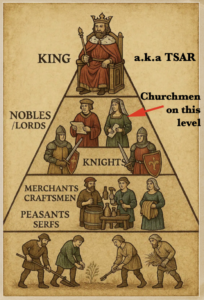
As she was born to a noble family and she entertained a substantive correspondence with emperors and popes, obviously she was not a powerless woman. Yet, as she was completely immersed in the feudal system of her time, she would be completely baffled by our notion of democracy or some of the progressive battles that we cherish.
Matthew Fox has rightly underscored her prophetic side. Just as for the prophets of the Old Testament, her visions were not simply predictive of the future but relative to the redress of injustice and imbalance in society. Her keen diagnosis of evil (see DM Aug 17) was an important piece of her thought, which she was able to share beyond the confines of her monastery not just through her books, but especially during a series of trips along the river Rhine.
Between 40 and 60 years of age, Hildegard devoted a lot of her time to writing. She became famous throughout Europe, but her books were actually read by only a handful of people, mostly monastics. Most of the population could not read and write, even less understand Latin; plus, books were hand-copied, resulting in a restricted circulation. But then, when she was about 60 years old, Hildegard was invited to speak to large crowds in the major cathedrals of cities along the Rhine, such as Mainz and Cologne.
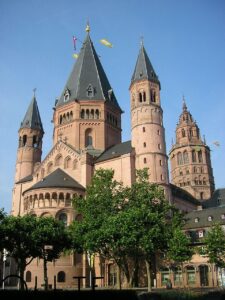
This invitation was nothing short of extraordinary, as women were not allowed to preach at all, and could not become teachers of men in any institutions. It has been speculated that her fame as as a visionary who was in direct contact with the living light — as she said — was the reason for such an exception. In any case, she spent the better part of ten years traveling for the purpose of giving public lectures to everybody, laity included.
We know what the topic of her speeches was, and we even possess the transcripts of some of them. She was upset by the laxity of clergy who did not truly care about their awesome pastoral duties, preferring to live a life of luxury, but she also depicted in a very bad light some of the new spiritual movements of her time, that she saw as creeping inside the holy church in order to destroy it. In short, the church to her was in danger both because of bad leaders and because of heretics.
She, instead, placed herself squarely within the Gregorian reform, a grand attempt to revitalize Christianity by raising capable spiritual leaders faithful to the pope, and by keeping at bay the more radical calls for change, which at times sounded like nothing less than a revolution.
In her public speeches, Hildegard warned the German people especially against the Cathars and other groups preaching voluntary poverty and extreme asceticism, calling them wolves in the guise of sheep. The Cathars, in particular, bought into a dualistic vision which rejected the goodness of matter in order to privilege the spirit. Nothing could be more alien to our abbess, who spent her life glorifying the immanent presence of the divine in everything material, viriditas in all creatures (see DM Aug 20).
Most historians, therefore, look at Hildegard as an agent of the important yet moderate 11th- and 12th-century reform coming from Rome, thus completely in tune with the bishops and abbots who invited her to speak and who were criticizing the other portion of the clergy who did not want to adhere to a more austere lifestyle, including renouncing marriage.
Yet Hildegard got in trouble with the ecclesiastical authorities in her seventies. This is an aspect of her politics which is shrouded in darkness for lack of information. We know that her monastery was placed under ecclesiastical interdict, which meant that mass could not be celebrated and psalms could not be sung, but only read. A very harsh measure against somebody who just a few years before was a heroine of the Church and whose music was an integral part of the spiritual experience of her nuns and guests alike.
We also know that the contention was around the burial of a heretic on the monastery’s grounds. The bishop wanted to exhume the corpse, perhaps to burn it publicly. Hildegard refused to give permission, claiming that the man had confessed his sins and was absolved before dying. I wish we knew who the man was, and why Hildegard remained so obstinate and defiant. Some sources say that she blessed the burial with her abbatial staff, and then proceeded to cancel all signs of the burial itself, so that it could not be found by the bishop.
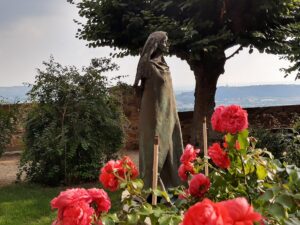
Lacking more information, this tells me that Hildegard did not let her compassion be trampled by obedience, and was ready to suffer a very harsh punishment for her and her nuns, rather than allow an injustice. Even the trashing of the honor of somebody who had been an adversary in life of the ecclesiastical party she belonged to.
The dispute ended, after several appeals, when Hildegard wrote a furious letter to the bishop asking if he really wanted to side with the devil by not allowing the praises of God to be sung, as it is proper and convenient. She won the fight, the interdict was lifted, and the heretic remained buried in holy ground.
ERRATA: In yesterday’s weekly summary for the August 24th DM, Albert Brooks was incorrectly described as being the current president of the American Enterprise Institute. He held that position between 2009 and 2019. We apologize for the misunderstanding.
To read the transcript of Matthew Fox’s video meditation, click HERE.
Banner Image: Painting of Cologne Cathedral, one of the places where Hildegard lectured. Art by Erwin Bowien. Wikimedia Commons.
Queries for Contemplation
What lessons can we derive from Hildegard’s politics, even though the sources to reconstruct it are not complete?
Related Readings by Matthew Fox
Hildegard of Bingen, A Saint for Our Times: Unleashing Her Power in the 21st Century
Creativity: Where the Divine and Human Meet
Hildegard of Bingen’s Book of Divine Works: With Letters & Songs
The Reinvention of Work: A New Vision of Livelihood For Our Time
Illuminations of Hildegard of Bingen
WHEE! We, wee All the Way Home: A Guide to Sensual Prophetic Spirituality
Gabriele Uhlein, Meditations with Hildegard of Bingen, Preface by Matthew Fox.


9 thoughts on “Hildegard’s Politics”
She was an amazing person, (I am so thankful her work and musical works are being brought into the light), and the chapter described today shows the strength of her faith, her individually developed faith. As a United Methodist, I heard in my childhood that our relationship with God is defined by the Bible, church tradition, and my own heart. I did then and still today find it a liberating way of being with the Creator. I take it seriously: Through study of many sources and working at creative thinking, I seek God and develop ways of acting that I feel advance God’s truth, that resonate with the God within me. I have great respect for people who think for themselves and who humbly follow the Way. Hildegard is far ahead of me in her reach, and it is good to know more about her life, beliefs and acts. Thank you for today’s message.
Thank-you, Matthew for your books on Hildegard (I have all 3), and thank-you, Gianluigi, for your Dailly messages on her. I love her, what a force of nature she was and is. I find her in my prayers and meditations sometimes, and I find myself addressing her. My favourite quote of hers: ” We shall awaken from our dullness and rise vigorously towards justice. If we fall in love with creation deeper and deeper, we shall respond to its endangerment with passion.” Written over 900 years ago ago and perfectly describes our disastrous position today. Blows my mind.
The video on the Cathars today came from The Helpful Christian website, which claims the Catholic Church as the one true religion. This is disturbing! The video seemed to support the bloody persecution of Cathars by the church and ongoing Inquisitions that Wikipedia identifies as early examples of genocide. The Cathars were a wealthy group that challenged church and clergy corruption and refused to send soldiers to the Crusades. I believe this sample focused on an exaggerated minority practice not representative of the majority. Regardless, the Cathars should not have been persecuted and “wiped out” of existence by the crown and church. Thanks for correcting this information.
I agree that the video is biased in the sense that it defends the actions of the Catholic Church way too much, avoiding going into the massacres of Cathars. It is historically correct that the response of the Church was in three phases: 1. discussion and debate; 2. crusade and eradication; 3. the Inquisition and survellaince. But, again, not even detailing the cruelty and numbers of killings is bad history.
We were looking for some video which could explain the Cathars’ belief system (the little that is actually known) and so we did not pay enough attention to the rest. To make up for this I will go into the Cathars history a bit more in the near future, also because it has become a topic in spiritual circles today.
We didn’t hear about Montsegur did we? And how many were burned at the stake for being “heretics”?
Thank you, G.G., for your essay and for including the video about the Albigensian heresy. The narrator asks a provocative question at the end, is the ancient gnostic philosophy from which the medieval heresies grew still alive today, making more trouble in society? I think of the widespread skepticism of science expressed by those who deny the benefits of vaccination which are supported by the mass of medical professionals. “Anti-vaxxers” are thus secular heretics. “Climate deniers” also prefer lies that condone (and even encourage) pollution to science-based conservationism and “green” ways to prevent species loss and extreme weather events caused by the polluting ways of industry and consumerism. The dualism that racked the ecclesial world and European culture then and since may be a perennial headache. Simplistic thinking and labeling of opponents as wicked extremists has a multi-millennial history. It’s a logical fallacy and propagandistic trope rather than a heresy. Today, anti-intellectualism and anti-elitism are kindred dangers seen in the mob appeal that only the non-college-educated are truly wise and virtuous. This lie is meant to manipulate and excite passions that reactionary despots here and overseas spread to suppress honest intellectual and academic discourse.
Question: I’m trying to remember, was it Hildegard or St. Teresa of Avila who kept the hierarchy of the Catholic church from attacking her more fiercely by adding to her letters to the clergy statements to the effect that “I am just a lowly woman who writes these things?” A clever ruse that allowed her to speak truth to power without being persecuted even more vehemently than she was.
It seems to me that with her ability to see the divine in everything and everyone, and to speak truth to power, that Hildegard was something of a populist activist. By which I mean that she likely cared deeply for all people and was not afraid to speak up when she perceived injustice or imbalance from the institutions of her time. But I am just getting to know her so it’s really more of a hot take.
I don’t really see how she could have transcended the typical role for women at that time without her position of privilege. But it seems she used it wisely. Quite remarkable when you think about it — it’s not an easy thing to be set apart from what’s considered “normal”, and then to flourish and impact others.
I love how she pushed back against the leaders of of her church for their excesses and hypocrisies… this theme seems evergreen and is with us stronger than ever today. We need more Hildegards!
She was a very gifted, holistic mystic and prophet. She was very open to the Divine Feminine Spirit of Love~Wisdom~Truth~Justice~Creativity~Compassion… working within, through, and among others in her daily creative Life…