
Our time is special for its emphasis on deep ecumenism or interfaith. Deep ecumenism, like the women’s movement (and I hope a healthy men’s movement), is a sign of hope in our times.
I was reminded of that once again in the recent exchange between Mirabai Starr and me, sponsored by the Interfaith movement book publisher, Kurt Johnson (see recording at right).
My book, One River, Many Wells: Wisdom Springing from Global Faiths, is a book about deep ecumenism. I created the term in my book on the Cosmic Christ and used it as a motif in my book on reinventing work because spiritual traditions of the world agree on basic elements of what renders work or right livelihood spiritual.
Deep ecumenism plays a vital role in my most recent book on Meister Eckhart, who, as D.T. Suzuki celebrates, was a pioneer in deep ecumenism. He stands on the shoulders of his mentor, Thomas Aquinas, who reached out to a “pagan scientist,” Aristotle, who was translated by Muslim philosophers, to totally recharge Christian theology in the 13th century and took immense flak for doing so. Of course, Eckhart influenced Thomas Merton profoundly in his groundbreaking work in deep ecumenism.
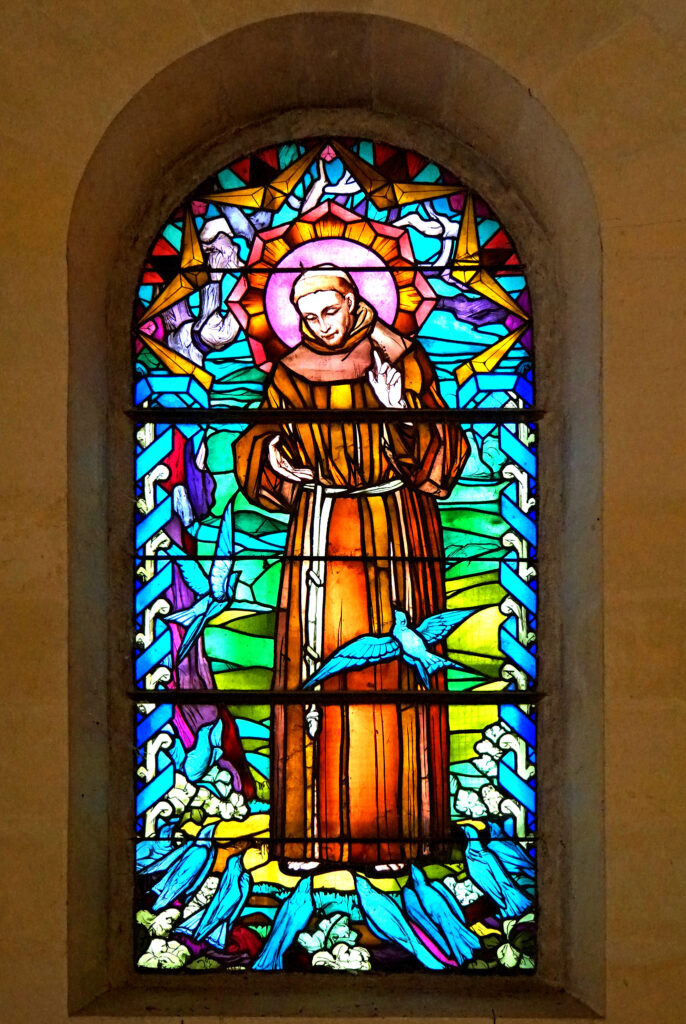
Here I share a prayer created by Francis of Assisi alongside a favorite prayer of the Dalai Lama.
St. Francis’ “Prayer for Peace” goes like this:
Lord, make me an instrument of your peace.
Where there is hatred let me sow love;
Where there is injury, pardon;
Where is doubt, faith;
Where there is despair, hope;
Where there is darkness, light;
Where there is sadness, joy.
O Divine Master, grant that I am not so much seek
To be consoled as to console;
To be understood as to understand;
To be loved as to love.
For it is in giving that we receive;
It is in pardoning that we are pardoned;
And it is in dying that we are born to eternal life.
Amen.
Notice the role of paradox in this poem—paradox is so often key to mystical language as it is to humor as well. Our deep life experiences are better expressed in paradox than in legal, declarative or dogmatic formulas.
Notice too that the one who is praying is asking to be changed. Francis is not saying that God is to be changed by our prayer, but we are. Such an understanding of prayer is more profound than prayer of petition that says: “Give me something that I want and do not have.” Francis is asking that he change and we change and not that God changes.
This corresponds accurately with Aquinas’s teaching that prayer changes us and not God.
Francis’ prayer is a plea that we live up to our fullest capacity—for what? For being instruments of peace, love, pardon, faith; hope, light, joy. And for learning to console, understand, love, give, pardon. And in the process, be born into “eternal life” now, in this lifetime.
A Buddhist prayer that the Dalai Lama likes to recite regularly comes from Shantideva, a Buddhist monk who lived around 700 AD.
May I be a guard for those who need protection
A guide for those on the path
A boat, a raft, a bridge for those who wish to cross the flood
May I be a lamp in the darkness
A resting place for the weary
A healing medicine for all who are sick
A vase of plenty, a tree of miracles
And for the boundless multitudes of living beings
May I bring sustenance and awakening
Enduring like the earth and sky
Until all beings are freed from sorrow
And all are awakened.
Do you feel a strong kinship between these two prayers?
Banner Image: L: Detail from the oldest portrait of St. Francis, a mural painting in the sacred grotto “St. Benedict’s Cave” in Subiaco. Wikimedia Commons. R: The Dalai Lama in 2012. Photo by Christopher Michel on Wikimedia Commons.
Queries for Contemplation
Are you challenged by these two prayers? How does each speak to you? How do you see them relating to one another? Is praying these prayers side by side a worthwhile spiritual practice for you?
Related Readings by Matthew Fox
One River, Many Wells: Wisdom Springing from Global Faiths
The Coming of the Cosmic Christ: The Healing of Mother Earth and the Birth of a Global Renaissance
Meister Eckhart: A Mystic-Warrior For Our Time
Prayer: A Radical Response to Life
The Reinvention of Work: A New Vision of Livelihood For Our Time
Christian Mystics: 365 Readings & Meditations
A Way To God: Thomas Merton’s Creation Spirituality Journey
Matthew Fox and Bishop Mark Andrus, Stations of the Cosmic Christ
The Hidden Spirituality of Men: Ten Metaphors to Awaken the Sacred Masculine
Charles Burack, ed., Matthew Fox: Essential Writings on Creation Spirituality


4 thoughts on “Two Prayers: One from St Francis & One from The Dalai Lama”
Many thanks, Matthew, for comparing Francis of Assisi’s “Make me an instrument” words to the Dalai Lama’s. A very happy juxtaposition, worth saving and reprinting together. One beautiful theme also present in both prayers is other-directedness, the attitude of the outstanding servant or shepherd. Not egocentrism (“I need this or I crave that”) but a consciousness that many we encounter or learn about have deep needs that we, as followers of Christ’s command to live by the Golden Rule, as channels of God’s gracious love, can help fulfill.
A minor correction in wording: after “O Divine Master,” the standard English words are “Grant that I may not so much seek to be consoled.”
Yes! Yes! Yes! Yes! To these two interrelated spiritual prayers that open Us to Our Source~Co-Creator’s Divine Love~Wisdom~Healing~Transformation~Freedom~Creativity~Compassion~Service~Loving Diverse Oneness… within and among Us in the Sacred Process of the Eternal Present Moment….
For some time, I have been struggling with the idea of petitionary prayer. If St. Paul says “pray without ceasing,” then surely that can’t mean praying for “things,” even if those “things” are prayer for a friend’s or relative’s healing or that all registered voters are allowed a ballot come this fall. The prayer by Shantideva, however … now that seems like the kind of petitionary prayer I can pray. In a way, this Buddhist prayer is an extension of the Prayer of St. Francis. By praying it daily, perhaps I can get over my resistance to petitionary prayer. https://www.youtube.com/watch?v=ijcYhn9qLj8&t=145s
My biggest problem with religion has always been the idea that there are so many of them, and they all think they are right. At some point I realized that all of them ARE right at their core, to varying degrees, and it’s the dogma of the religions that keeps us separated. I was not raised in a religious tradition and so I’m free to choose what I want without all the inherited trauma. Bits and pieces of everything.
I enjoyed these two prayers/poems. I don’t use prescribed prayers in my daily practice, I prefer to make up my own. But mine is very similar – I desire to be used as a tool, to go where needed, and to have the strength and presence to recognize when I need to take action, when I need to speak, when I need to listen, when I need to engage, or when I need to walk away. My work is to make my vessel as capable as possible of carrying out god’s will as I understand it. And remaining open and still enough to hear the guidance when it comes.