
In last Wednesday’s DM, “Bringing Back the ‘E’ Word”, I praised Susan Neiman’s recent book on Call It Evil: Understanding the Trump Era. She offers profound insight into the meaning and significance of Evil in our time. Here I share more of her contributions, especially as mid-term elections are staring us in the face.
I confess that I have felt quite lonely after my three books on Evil, and her book certainly clears any temptations to feel isolated on writing about this pressing topic. I see her book as a kind of companion piece to my previous books on Evil.
Of course, in recent DMs I have also applauded Gil Durán’s book, The Nerd Reich, and Naomi Klein and Astra Taylor’s, End Times Fascism. Both also offer substance in understanding the ongoing Evil in today’s world.
I offer one criticism to Neiman’s book however: She leaves out liberation theology and the base community movement of South and Central America. The author has a religious chip on her shoulder for sure (and understandably given so much bad religion that makes the headlines). But she seems ignorant of one of the healthiest religious movements of that past 100 years. This is a great lacuna, and underscores how secular philosophy has become.
It reminds me of a conversation I had with a philosopher at Villanova University who had written on Meister Eckhart, and responded to my first book on him, then called Breakthrough: Meister Eckhart’s Creation Spirituality in New Translation, this way. “I did not see the role of justice in his work. If you are right about him, all the rest of us are wrong.” I responded that so much philosophy is grounded in Hellenistic thinking and is antisemitic, leaving out Biblical teachings on justice and compassion. And Eckhart’s writings are very often sermons based on the Scriptures. Karl Marx recognized the prophetic tradition in Eckhart and built on it, as Marxist philosopher Ernst Bloch points out.
Now on to share more of Neiman’s contributions to a discussion on Evil. She rightly holds Albert Einstein up for his courageous stands on justice. She cites his declaration from 1934: “Striving for social justice is the most valuable thing to do in life.”
She calls him “fearless in defending causes that frighten others, despite threats of death and deportation….” FBI director J. Edgar Hoover “spent twenty-two years seeking something that would suffice to deport” him, tapping his mail and phone illegally, and the surveillance continued right up to the time of his death. By then, the FBI files on him numbered 1500 pages.
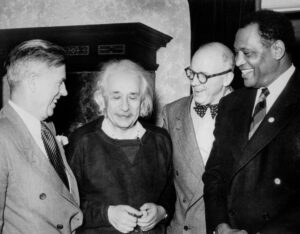
Einstein called racism America’s “worst disease.” While others shunned Paul Robeson, Einstein accepted his invitation to cochair the American Crusade to End Lynching. While turning down honorary degrees from Harvard and other schools, he accepted one from Lincoln University, the first American university offering higher education to African Americans. “His ethics were always universalist.”
While he supported the creation of a Jewish homeland, Einstein opposed the establishment of a Jewish state, concerned that it would fuel nationalism—“an infantile disease…the measles of mankind,” he called it. He supported a bi-national state in Palestine with “complete equality for the Arab citizens living in our midst.”
He believed socialism is “the only way to advance beyond the predatory phase of human development.” He taught: “Embedded in the tradition of the Jewish people there is a love of justice and reason which must continue to work for the good of all nations now and in the future.” In modern times, “this tradition has produced Spinoza and Karl Marx.” He never supported the Soviet Union however.
He warned of capitalism’s “oligarchy of private capital the enormous power of which cannot be effectively checked even by a democratically organized society.”* Relevant to today? It would seem so.
(To be continued in today’s video)
* Susan Neiman, Call It Evil: Understanding the Trump Era, pp. 195-203.
To read the transcript of Matthew Fox’s video meditation, click HERE.
Banner Image: The covers of three timely books: End Times Fascism, The Nerd Reich, and Call It Evil.
Queries for Contemplation
Do you agree with Einstein that “striving for social justice is the most valuable thing to do in life?” And that “the oligarchy of private capital” can rarely be “checked even by a democratically organized society”? And that, as Neiman and myself argue, Evil is a special word that needs to be named if we are to deal with it effectively?
Related Readings by Matthew Fox
Trump and the MAGA Movement as Anti-Christ: Recognizing the Archetype of Evil in Our Time.
Sins of the Spirit, Blessings of the Flesh: Transforming Evil in Soul and Society.
The Pope’s War: Why Ratzinger’ s Secret Crusade Has Imperiled the Church and How It Can Be Saved.
Passion For Creation: The Earth-Honoring Spirituality of Meister Eckhart (Formerly, Breakthrough: Meister Eckhart’s Creation Spirituality in New Translation).
Original Blessing: A Primer in Creation Spirituality.
Creation Spirituality: Liberating Gifts for the Peoples of the Earth.
A Spirituality Named Compassion: Uniting Mystical Awareness with Social Justice.
Charles Burack, ed., Matthew Fox: Essential Writings on Creation Spirituality.
Adam Bucko and Matthew Fox, Occupy Spirituality: A Radical Vision for a New Generation.

.jpg)

3 thoughts on “Neiman on Evil, continued”
I agree with Einstein that “striving for social justice is the most valuable thing to do in life,” and I especially agree with his 1946 call for a nationwide campaign, “to let the people know that a new type of thinking is essential.” Unfortunately, if the WWII cataclysm fostered social justice initiatives like the United Nations, decolonization, legal recognition of “genocide” and “crimes against humanity,” it also fostered the Cold War mentality, the 1948 Nakba and the subsequent ongoing crimes against the Palestinian Arabs, the mutation of “citizens” into “consumers,” unrestrained individualism and the ecological crisis.
In a recent interview published in the New York Times, the head of the International Committee of the Red Cross, Mirjana Spoljaric, said that some 130 armed conflicts are currently active around the globe!
The entire world is watching in dismay the obscene political and moral decay of leadership in a nation whose main entrance still features the once emblematic “Mother of Exiles” and her now-silent cry, “Give me your tired, your poor, Your huddled masses yearning to breathe free.” Will she too be gilded and, why not, renamed Lady MAGA? I pray for a massive resurgence of consciousness and dignity in the upcoming midterm elections. Short of it, Lord have mercy!
Yes! Yes! Yes! I would add the importance of Our spiritual journeys to include inner personal transformation as an essential part of social transformation. In yesterday’s DM response of the week’s summary, I mentioned an important recommended book that emphasizes this essential integration: David Nicol’s book, “Subtle Activism: The Inner Dimensions of Social and Planetary Transformation” (2015). This is a quote from the introduction of his book:
“Subtle activism is thus best understood, and practiced, as a creative component of an integrative spirituality that aims to encompass all domains of human experience. It is especially important to recognize that the processes of individual and collective transformation are profoundly intertwined.” (p. 4)
One can’t entirely agree with Einstein and Christ at the same time. Our first obligation, according to Christ, is to Love God with all our heart, soul and mind; but Einstein’s plea runs a close second. I find that to Love God above everything renders all else almost as a temporary charade. The key word here is “almost” because we cannot separate anything from God and we have a responsibility towards it; but God stands utterly supreme. In this, I would say, lies all the scripture, all the beauty, all the art, and all the meaning.