
Do you know that St. Francis of Assisi was a painter? I did not, and I suppose very few people do. Not many years ago, I had the privilege of spending a few days at a hermitage founded by St. Francis of Assisi, called today simply La Romita — i.e. “the romitory.”
There I learned that Francis, during one of his stays at the hermitage, painted on wood an antependium for the altar of that chapel, filling it with branches and birds. That painted wooden piece was still shown to visitors three centuries after his death, then it disappeared from the chronicles.
Undoubtedly St. Francis is the most recognizable saint of nature. His Canticle of Creatures — one of the first recognized works of Italian literature — has merited him fame, as well as the many anecdotes which place him in dialogue with non-human creatures. His itinerant lifestyle would have exposed him to more frequent contact with wild animals than the average city dweller, and it was reported that he engaged with them.
This aspect of him (via positiva) was exalted in the 19th century, while his radical social engagement (via transformativa) was downplayed. His suffering and deep contact with nothingness (via negativa) were also barely recognized until a few decades ago. Director Liliana Cavani explored the somber side of Francis in her movie Francesco (1989), showcasing his anguish and his sense of failure. Finally, his masterful inventiveness is evident in his creating a religious movement in a few years, besides his poetic skills and — as we now know — even his painting abilities (via creativa)!
There are good reasons, then, why Francis is listed as one of the six medieval patron saints of Creation Spirituality (see DM November 13). Nonetheless, I have a strong penchant for Saint Hildegard of Bingen rather than for Francis. If I had to choose just one patron saint for Creation Spirituality, I would choose her rather than him.
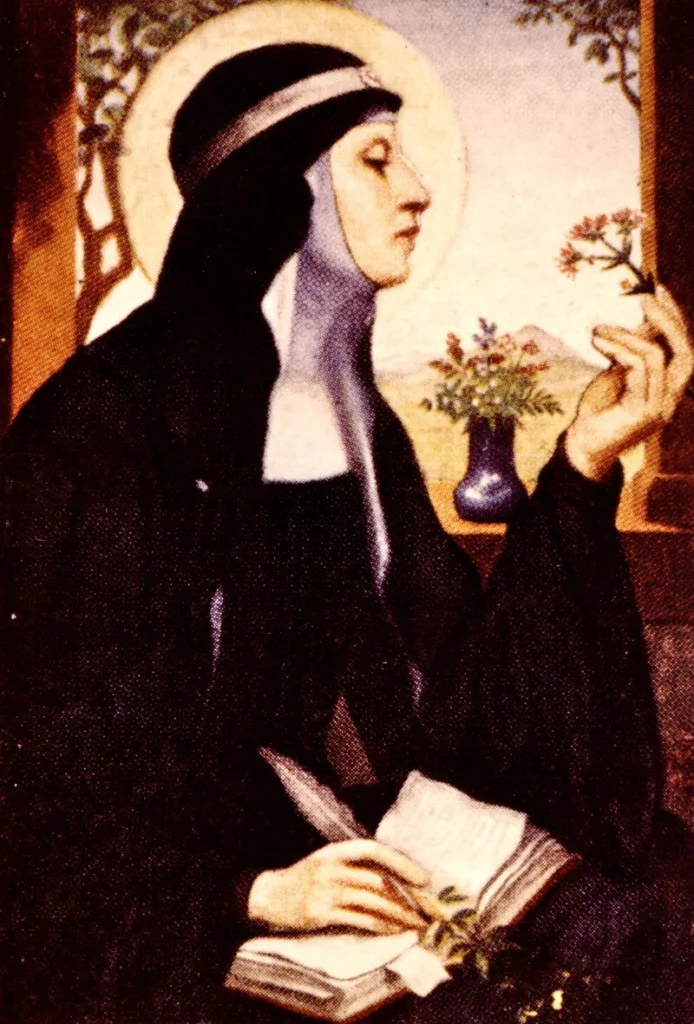
I asked myself why this thought percolates in my mind, given that it’s just silly to invent competitions among the saints. Why is she so attractive to me? I think that Hildegard represents at best the archetype of wholeness which is central to my spiritual quest, and arguably is the most needed archetype for our times.
Hildegard places healing — that is, reaching wholeness — at the center of her thoughts and actions. Her working with music, herbs, poetry, crystals, psychology, etc. etc. is unique not just because it bears witness to an exceptional woman, but because it is intended as a whole and as pointing to a whole in the human person. It is absolutely remarkable to me how she took the Augustinian notion of salvation, prevalent at her time, and she adapted it to fit a completely different psychological model, even though apparently she does not raise any critique to Augustine — it was hard and ill-fated for a university master such as Abelard to venture into explicit radical theological critiques in the 12th century, surely not an option for a woman.
At risk of simplifying the issue, but to make it as clear as possible, the Augustinian mindset is focused on the one inner wound as never really healed, almost as an inexhaustible source of meaning, while the Hildegardian mindset is centered on mending one’s wounds and bringing people back to the full enjoyment of life, mentally and bodily.
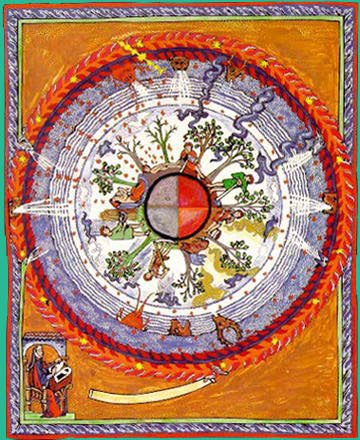
It has been observed by several commentators before me that her mandala-like paintings bear witness to her search for wholeness. I would say: it bears witness to the fact that the wholeness archetype had taken hold of her mind.
With Francis and Hildegard, we are not only dealing with two spiritual giants, but we are also dealing with our projections on them as images of our own souls and our own healing processes. Francis as an archetype himself resonates with our need for simplicity and radical action; his ecstatic praise of nature is integral to his efforts at holiness, which he called “naked following the naked Christ.” Hildegard as an archetype herself calls us to place our body/mind selves in the center of the living mandala, which is the universe.
They are not ultimately opposed at all, but their different accents are relevant to us and our own paths.
Banner Image: Stained glass windows of Saint Francis of Assisi (Holy Cross Monastery, West Park, New York, photo by Randy Greve on Flickr) and Hildegard as herbalist (cloister window, photo by Sheri on Flickr)
Queries for Contemplation
Without any need to choose between the two, what are the aspects of Francis and Hildegard that resonate with you the most?
Related Readings by Matthew Fox
Christian Mystics: 365 Readings & Meditations
A Spirituality Named Compassion: Uniting Mystical Awareness with Social Justice
Hildegard of Bingen, A Saint for Our Times: Unleashing Her Power in the 21st Century
One River, Many Wells: Wisdom Springing from Global Faiths
Hildegard of Bingen’s Book of Divine Works: With Letters & Songs
Creation Spirituality: Liberating Gifts for the Peoples of the Earth
Illuminations of Hildegard of Bingen
Original Blessing: A Primer in Creation Spirituality
Order of the Sacred Earth: An Intergenerational Vision of Love and Action


6 thoughts on “Francis and Hildegard”
Hildegard resonates with me the most because she seems so much more integrated than Francis in the fullness and wholeness of life, including in her relationship with her own body. Although the dominant image of Francis shows him in a very friendly relationship with nature and a favorite of bird bath aficionados, he also seems so self-hating and addicted to self-imposed suffering that, despite his admirable courage and charity, I do not adhere to this type of “poor-me” and shame-based spirituality. The human suffering caused by external factors should be enough to learn and to practice detachment and humility; adding one coat of self-induced pain and suffering seems neurotic to me. Sorry Francis if I am unfair: I very much appreciate The Canticle of the Creatures and I see the Laudato Si Encyclical of your namesake pope as a blueprint for a viable future, but I have long stopped self-flagellation.
They both came to understand, through an intuitive sense, the human condition; the miracle, beauty and divine perfection of simply Being. And it inevitably led them to a life of Love and Sacrifice, inspired utterly and totally by God from which they could never look back.
Thank you for this beautiful pairing of Francis and Hildegard. I had never heard that Francis painted, and learning that he made an antependium during a stay at a hermitage makes his Canticle of the Creatures feel even more tangible — praise expressed not only in words but with his hands. Hildegard’s focus on healing as reaching wholeness also stayed with me; her mandala-like images seem to hold together the very integration Francis points toward in creation. Rather than choosing between them, I found myself wondering how the via positiva of delight and the via creativa of making might meet in my own daily practice. A rich meditation to sit with.
They both inspire Our Faith in the Living Spirit of LOVE & BEAUTY of ongoing Co-Creation in Sacred Mother Earth/Her living creatures/Her Graceful abundance, and in All spiritual dimensions/Beings of Our evolving SACRED COSMOS in the Sacred Process of the Eternal Present Moment of OUR LOVING DIVERSE ONENESS….
I have always felt attracted to St. Francis. In 2011, I stayed in Assisi for four days and hiked to both San Damiano and the Hermitage to walk in the steps of St. Francis. I find it easier, somehow, to relate to St. Francis than to Jesus. I’ve often felt that the reason for that is that I can somewhat understand the Medieval period in Europe, but cannot get a handle on life in the first centuries in the Middle East. But what draws me to St. Francis even more than to several of the other mystics is his connection with Earth and its creatures–the idea that one can feel connected so much to animals, and rocks, to flowers, and rivers, to celestial entities that one can experience them viscerally, that one can speak to them. These are represented also in the Indian cultures of my land and to which also I am drawn.
There is something about Francis – a rawness, an immediacy, an authenticity – where he is out in the streets walking the walk. I sit in my privilege and fantasize about living that way. Giving up everything to the poor and being among them. If I get another incarnation maybe it will be so. Twice in my life I have sold everything, even lived in a tent for a while, and in my car the other time, but I found being poor to be too hard. My faith was weak then.
I also deeply resonate with Hildegard. She has such a strong essence and life force within her, and a keen intelligence. She spends much of her time in creative contemplation, offering deep insights. When I was younger I would spend hours alone painting and drawing, playing musical instruments, writing poetry and stories, and walking alone in the woods studying the plants and trees.
These days, as I approach 60 with health issues, I am seeking authenticity and vulnerability to be more like Francis, and open to reconnecting with my creativity like Hildegard. Although, I’m finding myself quite content to spend significant amounts of time on adventures with my eyes closed, and my heart open, balanced by engaging fully in community.