
There has been a resurgence of interest regarding the effects of lysergic acid diethylamide (LSD) on the brain, and particularly on its connection with spirituality, prayer, and mystical experiences.
Yesterday, August 21, in the online magazine Progressing Spirit, Matthew Fox published his comments about a scientific study which was conducted by the John Hopkins and NYU Schools of Medicine in 2016 but was published only now, almost ten years later, because of legal controversies.

I approach the subject using a framework that Matthew introduced in one of his early books, Whee! We, Wee All the Way Home: A Guide to a Sensual, Prophetic Spirituality, which I consider both important and one of the most undervalued works in his bibliography.
Matt’s frame of interpretation — which he also employs in the essay for Progressing Spirit — consists mainly in distinguishing natural ecstasies from tactical ecstasies. It is important to notice that such distinction does not involve a bias or a moral judgment toward the second type of ecstasies, but it does nonetheless engender some caveats.
Matthew says that natural ecstasies include such experiences as Nature, art, music, study, friendship, love-making, sports, travel, thinking, and involuntary deprivations. It is relevant to understand that the experience of ecstasy, starting with awe and wonder before a natural phenomenon such as a waterfall or a rainbow, is not rare or reserved to a few. How often do we realize, for example, that our friendships or our sport activities are in themselves ecstatic experiences, immediately available?
On the other side, tactical ecstasies constitute more elaborate practices, which are ways that human tribes have found for facilitating transcendent experiences. The use of LSD falls into this category, together with voluntary deprivations of food, sex, or sleep; all kinds of deep meditation, retreats in unfamiliar locations and altering habitual patterns; hypnotic chanting or dancing; the use of psychodynamic substances such as incense and ayahuasca, or intoxicating substances such as wine, tobacco, or absinthe.
For all tactical ecstasies Matthew offers the same structure of evaluation and caution, which I would summarize as follows:
- Are you aware of natural ecstasies and are you enjoying them? If not, please do so before proceeding.
- Is the strategy (i.e. tactics) that you intend to adopt in order to achieve ecstasy really necessary in your situation?
- Are you aware of the risks entailed in such a strategy, and do you have a way to evaluate its consequences in your life? Especially, as always in Creation Spirituality, is your experience conducive to social change?
The experience of ecstasy — that is, to be transported out of yourself — has always been sought after in all human cultures. It is frowned upon by those social systems which overvalue rationality and control. In reality, ecstasy is an integral and necessary aspect of human existence whose effects are often not limited to the experience itself but yield real breakthroughs.
Ecstatic experiences can and do open up the mind to possibilities that seemed hitherto non-existent to the individual. But what happens to ecstatic experiences in our present social system?

We don’t live any more in traditional settings where the use of tactical ecstasies is regulated by the ritual group, and thus abuse is kept in check. In those situations, the integration of the natural and the tactical is itself quite a natural thing. In our situation, instead, we often frame the question in terms of the individual’s choice, thus laying a heavier responsibility on the individual herself. Then we involve the law as an overarching frame, but often the law is outdated or too far from the real needs of people.
Matthew ends his essay in Progressing Spirit — which you can read here — with a cautious blessing on the regulated use of LSD in spiritual settings. His reasoning is based on the fact that people seem to really need it, especially though not exclusively clergy, like those involved in the scientific study mentioned above, who reported truly positive effects. Moreover, most churches have become completely unable to offer rituals that include or stimulate ecstatic experiences.
I agree, but I see the use of LSD almost as a desperate measure, which we all know includes some serious risks — we ALL know it: those in favor and those against, the people who administered the study and the participants, progressives and conservatives alike.
Thus, this should not be a battle but a conversation. In the spirit of such conversation I offer two open and provocative questions for debate:
1. What are we doing about the inability or unwillingness to experience natural ecstasies which — in my experience at least — seems to spread very rapidly in our societies? Is the access to stronger and stronger substances, including ayahuasca, the real answer that we are looking for?
2. Why are so many of my colleagues in ministry in such a dire situation, as described in the study cited? If we have religious leaders who are worse off — spiritually speaking — than their parishioners, shouldn’t we look at how the churches work internally, before looking at new external substances to fix the problem?
Matthew Fox, “Psychedelics, Mystical Experience, the Sacred and the Practical” in Progressing Spirit (note, the article is available only to subscribers)
See also Fox, Confessions: The Making of a Post-Denominational Priest
And Fox, Wrestling with the Prophets: Essays on Creation Spirituality and Everyday Life
And Fox, Creativity: Where the Divine and Human Meet
And Fox, Whee! We, wee All the Way Home: A Guide to a Sensual, Prophetic Spirituality
Banner Image: “Psilocybin-Psychedelic2.” Photo by Merlin Lightpainting/Pexels/Creative Commons. Published in Religion News Service with “After a decade of controversy, clergy psychedelic study is published” in Religion News Service.
Queries for Contemplation
What is your experience with natural and tactical ecstasies?
Related Readings by Matthew Fox

Confessions: The Making of a Post-Denominational Priest (Revised/Updated Edition)
Matthew Fox’s stirring autobiography, Confessions, reveals his personal, intellectual, and spiritual journey from altar boy, to Dominican priest, to his eventual break with the Vatican. Five new chapters in this revised and updated edition bring added perspective in light of the author’s continued journey, and his reflections on the current changes taking place in church, society and the environment.
“The unfolding story of this irrepressible spiritual revolutionary enlivens the mind and emboldens the heart — must reading for anyone interested in courage, creativity, and the future of religion.”
—Joanna Macy, author of World as Lover, World as Self

The Reinvention of Work: A New Vision of Livelihood For Our Time
Thomas Aquinas said, “To live well is to work well,” and in this bold call for the revitalization of daily work, Fox shares his vision of a world where our personal and professional lives are celebrated in harmony–a world where the self is not sacrificed for a job but is sanctified by authentic “soul work.”
“Fox approaches the level of poetry in describing the reciprocity that must be present between one’s inner and outer work…[A]n important road map to social change.” ~~ National Catholic Reporter

Wrestling with the Prophets: Essays on Creation Spirituality and Everyday Life
In one of his foundational works, Fox engages with some of history’s greatest mystics, philosophers, and prophets in profound and hard-hitting essays on such varied topics as Eco-Spirituality, AIDS, homosexuality, spiritual feminism, environmental revolution, Native American spirituality, Christian mysticism, Art and Spirituality, Art as Meditation, Interfaith or Deep Ecumenism and more.
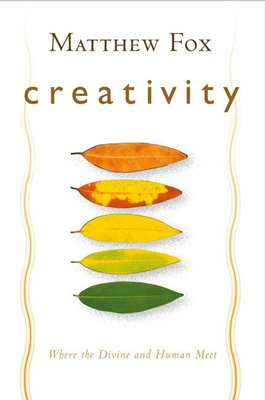
Creativity: Where the Divine and Human Meet
Because creativity is the key to both our genius and beauty as a species but also to our capacity for evil, we need to teach creativity and to teach ways of steering this God-like power in directions that promote love of life (biophilia) and not love of death (necrophilia). Pushing well beyond the bounds of conventional Christian doctrine, Fox’s focus on creativity attempts nothing less than to shape a new ethic.
“Matt Fox is a pilgrim who seeks a path into the church of tomorrow. Countless numbers will be happy to follow his lead.” –Bishop John Shelby Spong, author, Rescuing the Bible from Fundamentalism, Living in Sin

Whee! We, Wee All the Way Home: A Guide to Sensual Prophetic Spirituality
Years ahead of its time when first published in 1976, this book is still bold and relevant today. Perfect for anyone who thinks mysticism needs to get out of the head and into the body. Matthew Fox begins the Preface to this book by stating, “This is a practical book about waking up and returning to a biblical, justice-oriented spirituality. Such a spirituality is a way of passion that leads to compassion. Such a way is necessarily one of coming to our senses in every meaning of that phrase.” One of Matthew Fox’s earliest books, this title explores the importance of ecstasy in the spiritual life. Fox considers the distinction between “natural” ecstasies (including nature, sex, friendship, music, art) and “tactical” ecstasies (like meditation, fasting, chanting); he goes on to consider that a truly authentic mysticism must be sensuous in its orientation, so to cultivate the maximum amount of ecstasy for the maximum amount of people.


5 thoughts on “Ecstasies”
I’m a natural Plotinus/Eckhart type mystic. I had my “mystical experience” when I was about 20, learned about it (gradually) when I was about 30, and have been exploring it, to various degrees, ever since (I’m in my late 60’s).
For people who have a history of mental illness in their family, as I do, the “drug route” is completely off limits. It is inconceivable to put any kind of drug into the brain of people with such a familial risk. I also find it mind-boggling that there is so much fanaticism about “drug-induced ecstasy”– not for the few, but for the crowd. And pot is so much more potent/lethal now.
The ecstasy of natural means, which I had, is rarer but still accessible to many people. It is much more “user-friendly” than just Plotinus’ model: his is one model among many. Eckhart’s is another. Mine is a third (although mine is less delineated than either of those two). But you get my point: the Mystical model is a sketch that shows the brain a MUCH bigger picture, and plots things in it while helping move people along to a higher point. It is a wide-image, GROWING image-model which helps people orient and move through it (usually). It IS the “BIG G*D IMAGE”. And it does NOT require drugs.
I’m not sure if I clarified the point, but the Mystical Model is one of participation and personal transformation. It’s completely natural. And it is widely available, in Christian/Jewish/Sufi/Hindu forms.
Thank you Gianluigi. Personally, I find the name “tactical ecstasies” more appealing than “spiritual technologies”, as such practices are sometimes called. Carefully supervised tactical ecstasies are indeed very helpful ways of exploring Life beyond the necessary but confining frame of the ego. Those wary of the potentially addictive psychotropic substances used in that context may turn instead to holotropic breathwork, a technique developed by Stanislav and Christina Grof who led widely attended sessions at various events organized in the mid ’90s by the International Transpersonal Association (ITA). Incidentally, Matthew.Fox was often a guest speaker and a much appreciated conductor of unforgettable rituals during these international gatherings.
Thank you for your very thoughtful questions. I would just add, what is the point of ecstasy? Is it just to experience something outside of oneself for its own sake or does it lead to connections with the holy? As you point out, the experience is meant to result in positive social change. It seems more helpful to teach/encourage natural ecstasies rather than to rely on drugs–there are so many ways to reach a natural high. At the same time I honor the Native American practice of peyote because it is very carefully managed.
Natural ecstasies are part of our spiritual transformations on our spiritual journeys of experiencing Our Divine Loving Diverse ONENESS with Sacred Mother Earth and with All of ongoing evolution in Our multidimensional/multiverse Co-Creation/Cosmos — COMPASSIONATE COSMIC CHRIST-BUDDHA CONSCIOUSNESS — in Our ETERNAL LOVING SOULS….
The Psychedelic Explorer’s Guide by James Fadiman, and LSD and the Mind of the Universe by Christopher M. Bache are two very good resource books. I ended up under the impression that if one could access unadulterated LSD that it should be taken in the company of two persons who were well experienced with LSD. Choice of location and music to be played during the experience are part of the preparatory process. The experience lasts the better part of a day and following the experience the person should be checked up on afterwards in a few days and then again a bit later. They should also have a community of experienced experimenters to return to for support. This kind of rigorous shepherding allows for weeding out people who might be at risk for participating or providing guidance during some momentary challenging scenario that might come up during the trip.