
If I look at the religious factor within society from a detached point of view — to the extent that I am able to do so, having gotten a Ph.D. in “religion” — I cannot help but see that religion played a very negative role in the history of Europe and, by extension, what we call “the West.” Surely the Crusades in the Middle Ages and the Protestant-Catholic wars in the modern era also had non-religious motivations, but it would be disingenuous to play down the power of religious convictions and institutions in those conflicts.
It is tragically ironic that, for example, the movement of God’s Truce, sponsored by medieval clergy, which sought to widen and widen with the passing of time the number of calendar days in which the feudal lords could not fight against each other, obtained the unity of such lords under Christ’s banner only when they coalesced against “the other” in the Crusades against the Muslims, as well as against “heretics.”
In the church of St. Dominic in the city of Casale Monferrato, visitors as well as the faithful can see a gigantic 18th-century painting depicting the slaughter of the Cathars — early 13th century in southern France — which includes a Dominican brother, surrounded by divine light in the midst of broken bodies, who incites the slaughter. I can walk there during school breaks, in case I need a reminder of the harsh historical reality of religion. At about the same distance from my new home lies the village of Monforte d’Alba, where in the 11th century a big pyre was lit to burn alive a group of people who followed meditation practices perhaps akin to those of the alumbrados in 16th-century Spain.

So it is not surprising that scholars of international relations (see yesterday’s DM) don’t seem to be especially interested in the role of religion for the solution of conflicts. It is beyond doubt that the modern rational mindset — not religious folks — forged for the first time, 400 years ago, over the ruins of the wars of religion, the international assets of regulations and reciprocal recognition which are now being shattered.
It is especially bothersome in this context, that while we seem to go back to the rule of sheer power and dominance, that is, to the imperial mindset, a certain kind of religion resurfaces. Shamelessly, from my point of view, some evangelicals use the name of Christ again to justify conquest and horror. But, in a strange way, they have history on their side!
How could I then convince any scholar of international relations that religion, and more specifically Christianity, could play a positive role in the search for a new world order, after the collapse of the present one? I don’t want simply to point out, for example, Pope Leo’s open defiance of Trump, because I am looking for a structural answer.
I think that I would underline how Christianity as a movement was born in an imperial context just like ours, and that, as long as it was not the religion of the majority, or the religion of the state, it was Christians who insisted on the equal dignity of every human being.
The Pauline communities that spread in cities all around the Mediterranean in the middle of the first century must have been quite remarkable because they included slaves and married women — without their husbands! — and kept preaching equality between rich and poor as long as they could.
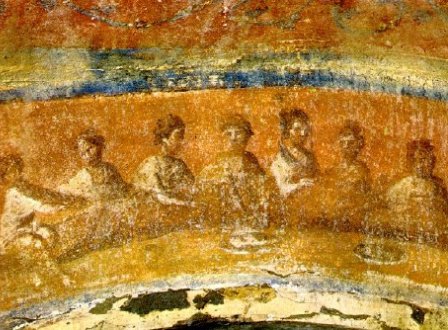
Truly, Epicurus had admitted women and slaves in his Garden in Athens, three centuries earlier, and some Stoics allowed that women had the same rational capacities as men, but these precedents did not have the same social impact as the early Christian movement, which spread like fire at all levels of society in the course of two centuries (about 70-270) until emperors had to deal with it seriously.
In his book on Trump and MAGA as an Antichrist, Matthew Fox asks: Does Jesus teach about democracy? And does Christ represent democracy in some way? The answer is in the positive for both questions, that is, both on the historical level — the teachings of Jesus are about the infinite value of each human being — and on the symbolic level — the image of Christ evokes those teachings in a very deep way.
Matthew in particular finds that the thread of true Christianity did not disappear in history, despite the deadly alliance of the Church with the Empire. It resurfaces, for example, in the teaching of Thomas Aquinas and Meister Eckhart. Aquinas: “Christ teaches the dignity of human nature… and the full participation in Divinity.” Eckhart, in turn, recognizes that the teaching of Jesus on love and justice leads to equality, and therefore democracy. The pivotal point being that Christ’s whole nobility belongs equally to us all.

This is not democracy in the same sense as Thomas Jefferson’s, but it is a broader understanding of it. For Eckhart does not limit the dignity of personhood to white people or to men or to men with property, as did Jefferson in practice if not on paper (…). In Eckhart’s view, based on the teachings of Jesus, “there can be no love where love does not find equality or does not create equality.”
Banner Image: Slaughter in the name of Christ: “Taking of Jerusalem by the Crusaders, 15th July 1099.” Painting by Émile Signol, 1847. Wikimedia Commons.
Queries for Contemplation
Do you think that the message of Jesus and the Christ-symbol can have a political impact nowadays?
Related Readings by Matthew Fox
Trump & The MAGA Movement as Anti-Christ, pp. 32-36
Sins of the Spirit, Blessings of the Flesh: Transforming Evil in Soul and Society
The Pope’s War: Why Ratzinger’s Secret Crusade Has Imperiled the Church and How It Can Be Saved
Meister Eckhart: A Mystic Warrior for Our Time
The Tao of Thomas Aquinas: Fierce Wisdom for Hard Times
A Spirituality Named Compassion: Uniting Mystical Awareness with Social Justice
Charles Burack, ed., Matthew Fox: Essential Writings on Creation Spirituality


6 thoughts on “Jesus, Christ, and a New World Order”
It has always been interesting to me that Western Europe, with its mostly empty pews, incorporated and institutionalized many of the teachings of Jesus in their governmental structures. Taxes are used for adequate healthcare and education. Daycare for children appears abundant and of high quality. Unions are strong. The basic needs of citizens seem to be met. I say that as a U.S. citizen, observing from afar…..As for all the religious wars, I wonder if Christian values were distorted by the powerful to rally the troops so to speak in order to enrich the already rich and powerful. Seems like standard colonialism to me…religion being the pretense.
Unfortunately, the teachings of Christ are historically so deeply associated with righteousness, mind control, abuse of power, persecution, and a Christian version of political jihad (which itself is a perversion of spiritual jihad, the inner process of spiritual alchemy), that they can hardly be met without the negative interference of the transgenerational memory generated by the Church abuses. I would compare this with the difference between reading a bad biography and meeting the person whose life is narrated. Dostoevsky’s story of The Great Inquisitor sums up the chasm between the original teachings of Christ and those of the self-righteous Christ impersonators. If a dark-skinned Christ wearing the Palestinian keffiyeh came back to Washington today and ventured to pronounce a “Sermon on the National Mall,” we all know who would send ICE after him and lock him up or worse…
But, Luigi, Eckhart did not condemn the killing of Marguerite Poiret!
Matthew Fox quotes Eckhart in very carefully-tailored parts, to highlight the mystical universality, usefulness and friendliness of Eckhart. But he ignores vast amounts of Eckhart’s writings which are important for showing Eckhart’s usual focus on mystical precision. Eckhart usually wrote for a much more narrowly-focused audience than Fox does. but Eckhart was also a product of his times and his place.
Each Mystic, in all the major religions where this Mysticism shows up, deals with his (or more rarely her) own societies’ focuses and their own biases. And each writer OF this Mysticism, if they are NOT a Mystic, also exhibits their own bias, which may misunderstand some of the Mysticism.
As to whether Jesus/Christ’s Mystical message can have a political impact today, I think this may be a misleading direction. Jesus talked about people getting away from “group-think” and politics, and working on their own or in small groups of like-minded people, AMIDST the crowd. A Jesus/Christ- minded, mystical person CAN have a political impact, but politics is secondary to their personal growth. It would take a VERY balanced Jesus-minded Mystic to navigate the challenges and temptations of politics.
We could hope, though, that politicians are spiritually well-grounded…
Yes, if the Christ symbol is regarded and experienced as a universal mystical human symbol/consciousness of Divine Love within All Humanity — personally, communally, and cosmically in Our Loving Diverse Oneness with Sacred Mother Earth and Our evolving Sacred Cosmos, within All physical/nonphysical spiritual dimensions and beings, in the sacrament of the Eternal Present Moment….
Jesus spoke of the “narrow way,” and I imagine someone on a tightrope: one misstep and you fail utterly, lose your life. And yet God is infinitely greater than a rule enforcer. God forgives those who act out of ignorance or irrational fears. The human race and the world of vulnerable matter suffer and inflict suffering on all that live. Evolution destroys much as the power of Teilhard’s ultimate mystery progresses. Jesus said, “Fear is unnecssary; what is needed is trust.” St. John opines that the transformations of people and our world are inconceivable. St. Paul, using no description, shared his rapturous sensation of what God has in store. What can be dreamed and hoped for twenty centuries later? I may be too in love with the world and people I know to open my imagination to what is infinitely possible, so I trust.