
In the collection of ancient books that we call the Bible, trees are mostly presented as symbols of life, prosperity, and fruitfulness. They are recognized by species — about 15 of them — with those that are more common in Palestine having pride of place, including oaks, fig trees, olive trees, pomegranate trees, and date palms.

It is the same all around the world: all religious texts are replete with trees, starting with the most venerable Bodhi tree under which Gautama reached enlightenment, and including the continual reference to trees and forests in what we call Daoism and Hinduism. The Ramayana mentions 182 kinds of plants, thus probably surpassing any other individual book.
It takes little to realize that religious cultures all around the world have always given importance to trees. Trees can have symbolic meaning, but often they are just recognized as creatures which provide shade or wood or food — thus having instrumental value — or are simply beautiful — which is in part a way to talk about their intrinsic value and their right to exist.
The Psalms often talk about trees as symbols of uprightness and fruitfulness, starting with the very first one which talks about the righteous in this way: They are like trees planted by streams of water, which yield their fruit in its season, and their leaves do not wither. In all that they do, they prosper.
Psalm 94 echoes Psalm 1 and says: The righteous will flourish like a palm tree; they will grow like a cedar of Lebanon; planted in the house of the Lord, they will flourish in the courts of our God. They will still bear fruit in old age, they will stay fresh and green. The “viriditas” (greening power) of which Hildegard of Bingen will become a champion in the 12th century finds its roots here.

The narrative books in the Bible provide many citations of trees, among which the most curious is the parable of Jotham in the book of Judges. Four different trees are asked to become the king of all trees. The olive tree, the fig tree, and the vine turn down the proposal, one after the other, because the job would entail a lesser focus on their proper activity of producing sweet and useful fruits. At last, the brumble tree —which is thorny and fruitless — accepts the proposal, boasting about its nonexistent capability of making shade for others (see Judges 9).
Such a sarcastic critique of the human desire to lord over other people is ancient wisdom learned from the plant realm, even though today we might want to consider the value of brumble trees for the ecosystem.
The prophetic books are also replete with trees. About the renewed people of God, the Book of Isaiah exclaims: They will be called oaks of righteousness (Isaiah 61:3). Apparently, to be known as trees, and having the quality of trees, such as stability and the capacity of providing ample shade for others, is quite a good thing for human beings.
Yet the prophetic books, as well as Deuteronomy, are also the texts where the association between trees and “illicit cults” comes forward. In the rules and regulations that comprise the book of Deuteronomy, one finds two major prohibitions concerning trees, which can be summarized as: Thou shall not cut down any fruit tree and Thou shall not plant any tree to represent the divinity (see Deuteronomy 20:20 and 16:21).
The first commandment can be quoted as an early text regarding the rights of trees — albeit quite limited — while the second commandment is an explicit reference to the worship of the “sacred pole” representing either the female divine companion of the male tribal God of Israel, or the female “ladder” to Him. In any case, the prophetic books — like Deuteronomy — are adamantly opposed to such a cult.
It appears that the cult of Asherah, embodied in a living tree, would give to women and to the female principle of fertility a role that the prophets of IHWH wanted to see as enacted by the male God alone. The connection between the strong repression of women — and/or the female principle — and the equally strong social justice advocacy — in favor especially of poor women — both supported by the same prophetic books, is something that should bother any biblical interpreter.
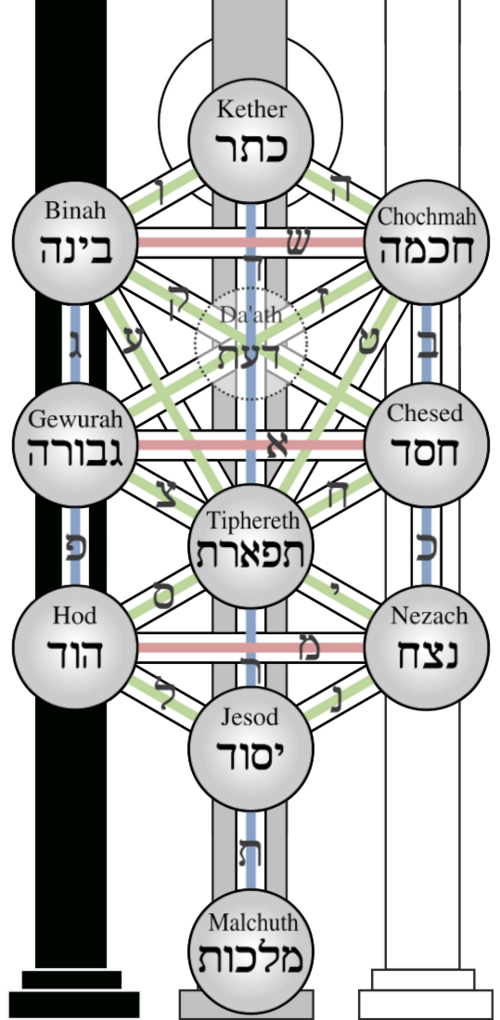
It is instructive, however, that the second story of the creation of the world in the book of Genesis presents a living tree as the center of the world, surrounded by many other living trees which together comprise the garden of Eden, that is, the best place one can imagine for one’s life. Such a “tree of life” evokes the mythical tree of many different cultures and is also the historical precursor of the Sephirot tree of the Kabbalah.
In the New Testament, expressions abound about “bringing fruit” — understood as works of mercy and justice — declare its strong connection with its Jewish roots. The modern reduction of religious experience to a relationship between God and the soul — based on a phrase by Augustine of Hippo — leaving out nature and trees entirely, is very unbiblical. Yet the inclusion of trees as partners in our spiritual and political awareness is quite a new phenomenon.
Banner Image: Cedar of Lebanon, Barouk. Photo by Olivier BEZES on Wikimedia Commons.
Queries for Contemplation
What role do trees have in your spirituality? Do you see a special connection between the female principle, or female energies, and trees?
Related Readings by Matthew Fox
Matthew Fox, Skylar Wilson, and Jennifer Listug, Order of the Sacred Earth: An Intergenerational Vision of Love and Action
Original Blessing: A Primer in Creation Spirituality
The Coming of the Cosmic Christ: The Healing of Mother Earth and the Birth of a Global Renaissance
Creation Spirituality: Liberating Gifts for the Peoples of the Earth
Matthew Fox and Rupert Sheldrake, Natural Grace: Dialogues on creation, darkness, and the soul in spirituality and science
A Spirituality Named Compassion: Uniting Mystical Awareness with Social Justice
One River, Many Wells: Wisdom Springing from Global Faiths
The Hidden Spirituality of Men: Ten Metaphors to Awaken the Sacred Masculine
Naming the Unnameable: 89 Wonderful and Useful Names for God…Including the Unnameable God


6 thoughts on “Trees in the Bible”
Trees are my favorite teachers because they are at the same time grounded and aerial, collegial and highly individualized, patient and resilient through seasonal cycles and weather upheavals, humble and proud facing their destiny, open and generous towards the animal kingdom, and because, like the Eternal Feminine in Goethe’s Faust, they “draw us upward.” I love them also because they are totally indifferent to the human attributes I project on them. Were they created out of love for birds and squirrels, or birds and squirrels out of love for trees? Wangarĩ Maathai, the first African woman to win the Nobel Peace Prize has endowed the Earth with millions of trees; we may ponder these words attributed to her: “Until you dig a hole, you plant a tree, you water it and make it survive, you haven’t done a thing. You are just talking.”
As I sit here reading your meditation, I am looking at a maple tree my wife and I planted 30 years ago. Now it towers over our home and its roots extend under our home’s foundation. It is solid and straight and provides ample shade. Thank you for helping me refocus on the importance of trees. Particularly on the fact we have focused on the spirituality of the soul but not on the spirituality of trees.
I am literally a tree hugger🌲when I go into the forest I will usually make contact, grateful they are there.
Thanks Gigi and blessings to you
I’m just finishing :To Speak for the Trees” by Diana Beresford-Kroeger. Please, please read this book! I know she has written others, but this was recommended by a friend who also loves trees. This book gave me hope during this time when it is in short supply for me.
Yes, the symbol of Trees can represent historically and presently the Living Divine Feminine among many manifestations, both physical and nonphysical spiritual dimensions/Beings, of Her Beautiful Creations, including ourselves as unique Co-Creative human~Divine creatures that make up Our Loving Diverse Evolving Oneness in the Sacrament of the Eternal Present Moment….
Trees, as glorious as they are for me, do not symbolize the female. Trees reproduce in all kinds of ways — male and female on the same plant; or on different plants; or either one reproducing by root; or even the one gender switching to the other on the same plant. Trees enjoy variety!
In the ORIGINAL Creation narrative of Genesis 1, men and women were ONE. This is being true to the Mystical Revelation that supports the Bible. It does NOT have gender — either one — in either its primary “God” Revelation OR its “secondary (but still Mystical ) “Christ” Revelation. Female, like male, is a Divine Creation of ONE (NON-specific).
We (humans) decided to put males in a semi-divine status, but Jesus had females being equal to males, and slaves equal to free. It was the Church and society that turned Christianity, once again, into a male hierarchy power-trip.