
When Matthew Fox was silenced by the Vatican, that is, in the second half of the 1980s, many other Catholic theologians were similarly betrayed. Dismissals, condemnations, job losses, loss of community and friendships… all kinds of strategies were employed by Ratzinger — then at the head of the Inquisition — to deal a blow to the very real possibility that the largest Christian denomination on earth would become a hub for social transformation.
Theological dialogue within the Roman Catholic Church was going to be stunted for decades, and it has hardly recovered.
It’s ironic that most people who know something about the Catholic Church, but have not studied the issue in any depth, talk of Ratzinger — later pope Benedict XVI — as a “great theologian.” By all measurements available to the theological academy, he was a mediocre thinker. He was also a cruel human being, who managed through some very obscure methods to be elected to the highest positions.
In any case, it seems to me that three men were especially targeted at that time, each being the best-selling Catholic theologian in one geographical area: Matthew Fox in North America, Leonardo Boff in South America, and Eugen Drewermann in Europe. Each of them was bringing a revolutionary perspective, elaborated independently of one another, even though obviously dependent on the studies and efforts of many before them.
Those three visions, when combined and favored by the Church authorities, could have produced such a massive transformation that we would live in a different world today. After all, then the Catholic Church still exercised a great deal of cultural influence. Instead, the old Roman saying “divide and conquer” was implemented single-handedly by Ratzinger, with the staunch approval of John Paul II.
What prevents us, today, from going back to that moment in time and imagining what the merging of these three perspectives can still mean for us? It is true that — as Matthew Fox has explained — each was tuned to its specific geo-cultural context and offered paths specific to such context. However, the contacts that happened between those three perspectives at that time, as well as afterwards, are a clear enough indication that a cross-fertilization is possible.
I am thinking, for example, of Matthew’s trip to Brazil and his meeting with Leonardo Boff, as recounted in his autobiography. The results of that trip can be glimpsed in Matthew’s book Creation Spirituality: Liberating Gifts for the Peoples of the Earth (1991), in which Matthew underscores the essential point of contact between Liberation Theology, championed by Leonardo, and Creation Spirituality itself. Wisdom education and ecclesiogenesis are the two main points of consonance.
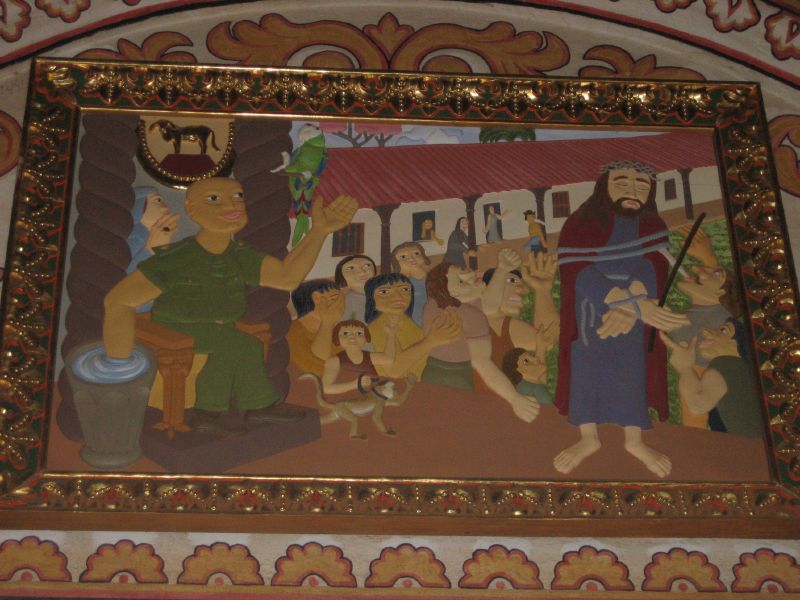
Ecclesiogenesis means birthing the Church in new ways, independent of existing structures. Boff at that time was speaking of the history of the church as “genuine history,” that is, the creation of never-before-experienced novelty, by means of the base communities, that is, places where people are speaking and acting from their own experience. Matthew responded by pointing to his own unreserved welcoming of feminism as kind of picklock to open up the moldy rooms of church meetings, and he cites with hope all the places in North America practicing a circular kind of sharing.
Wisdom education, which Matthew pursued and keeps pursuing, is a desperately needed alternative to the very dry and boring Western school system. It means teaching ways to open and strenghten the heart and create harmony with earth, self, other species, and with the creative “mind” of the universe. This project also echoes deeply with Boff’s call to reinvent teaching, learning, and even theology itself. People learn from people, and the theologians — who claims to deal with the highest possible subject, the divine itself — must learn from common people, aside from books, if theology is to be first and foremost a liberating practice.
Both Matthew Fox and Leonardo Boff, as well as Eugen Drewermann, were silenced. The Church authorities tried to humiliate them in open as well as subtle ways. This kind of suppression, however, may work only for a while. If the seed is strong and true, it will prevail. I am thinking of the moment when we realized that one of the main authors behind pope Francis’ encyclical Laudato Si‘ was one of Matthew’s students, and that Leonardo was directly consulted by the Vatican during the writing of it. Sprouts will keep showing up, I am sure.
Matthew says that one of his favorite music pieces is Leonard Bernstein’s aria about how the word of God cannot be chained. In fact, the message of each of the three theologians I am focusing on continues one, and each of them individually thrived in their own way. Nothing should hold us back from studying their works today and imagine a cross-fertilization of kind. I think that this effort might reveal itself as a very productive avenue for a global culture that seems completely unable to look into its own depths, as these three authors instead have been doing for decades.
In the next few DMs, I would like in particular to discuss the work of Eugen Drewermann and its points of contact with Creation Spirituality, as this particular bridge has been less explored than the one between Fox and Boff that I have briefly sketched above.
Banner Image: Prophetic Dissenters: L-R: Eugen Drewerman (Wikimedia Commons, public domain), Matthew Fox (Photo by Bridgette O’Leary, used with permission), and Leonardo Boff (Wikimedia Commons).
Queries for Contemplation
Are you aware of Liberation Theology? What are its major ideas that have influenced you (if any)? What would you be curious to know about it?
Related Readings by Matthew Fox
Confessions: The Making of a Post-Denominational Priest
The Pope’s War: Why Ratzinger’s Secret Crusade Has Imperiled the Church and How It Can Be Saved
Original Blessing: A Primer in Creation Spirituality
Creation Spirituality: Liberating Gifts for the Peoples of the Earth
Wrestling with the Prophets: Essays on Creation Spirituality and Everyday Life
The Coming of the Cosmic Christ: The Healing of Mother Earth and the Birth of a Global Renaissance
The A.W.E. Project: Reinventing Education, Reinventing the Human
Occupy Spirituality: A Radical Vision for a New Generation
A Spirituality Named Compassion: Uniting Mystical Awareness with Social Justice


.jpeg)
7 thoughts on “Three Theologians Fought the Vatican”
I’m old now but in the eighties I watched in horror what was happening to Fr. Matthew Fox and the way Ratzinger was humiliating the American religious sisters. I was just starting to read about feminist theology and while I hung in as long as I could the pain of going to mass and listening to what some priests were preaching was too much. Thank you for this email it brought me to tears.
I am aware of liberation theology, but yes, would like to know more.
Yes this subject area is interesting and would like to know more but just as much why the established Roman Catholic Church is so resistant to what seems clearly the inspired teachings of Christ. A deferential awareness for the societal poor and underprivileged. Is salvation only a private, personal matter?
I have never heard of Liberation Theology. I have a very limited academic understanding of spirituality and theology and I’m quite content to keep it that way. I’d prefer direct experiences.
The whole notion of a central church feels broken to me. God is accessible to anyone at any time – in fact we ARE god, each of us. A central church in my mind does nothing but politically manipulate people for money and power. Much like capitalism.
I feel we are moving away from needing permission to gain access to spirituality, towards a population of every day mystics. No longer do we need to be servants to some doctrine, but rather we can create our own. No longer do we need to be told we are doing it wrong, or that we are somehow damaged. We can experience this existence with our own senses and sensibilities and come to our own conclusions.
I will make an effort to learn about Liberation Theology. But I don’t believe any theology will liberate anyone as long as capitalism rules the world. That’s the elephant in the room.
I reserve the right to change my opinions as I learn more 🙂
Yes! I enjoyed the two enclosed video interviews of Matthew Fox in today’s DM. I enjoyed his articulation of holistic Creationg Spirituality, which includes Liberation Spirituality, Indigenous Spirituality, Feminist Spirituality, Earth Spirituality, Mystic Spirituality and Cosmic Spirituality… of Divine Love~Wisdom~Creativity in Our Eternal Human~Cosmic Evolution….
Listening to Matthew speak recently about his upcoming book on Pere Chenu I learned that both Creation Spirituality and Liberation Theology were inspired by Pere Chenu’s teachings in Paris in the 1960s.
This summer I read an essay by a woman named Mary Jo Leddy who started a newspaper in Toronto in the 1970s called Catholic New Times that reported on liberation theology in Latin America. Liberation theology did not catch on in Toronto.
Now that people in North America are faced with serious existential threats like the climate crisis, AI, and fascism I wonder if a taste or appetite for liberation theology and creation spirituality will emerge. Dialectically possible.
I read a bio of Pope Leo by Elise Allen and learned that Pope Leo, in addition to being an American, is a citizen of Peru and he was friends in Peru with Gustavo Gutierrez, the father of liberation theology.
So Pope Leo had direct contact with libration theology and he is the second Latin American pope in a row.
Plus, as Matthew pointed out, he uses the phrase “original goodness” in graph 20 of Magnifica Humanitas.
Something is going on. The generals, CEOs, and tech bros have atomized societies, creation is being destroyed, and AI is going to vaporize humanity by 2030. Will the winds of change blow a new wave of liberation theology and creation spirituality through North America? Just in time, to use a supply chain metaphor.
Looking forward to Matthew’s book on Pere Chenu.
I want to start by acknowledging what a beautiful profile this is of Matthew. It’s inspiring to learn more about his commitment to this movement and the role he played in challenging the church to reconsider what it could become.
Reading this also made me think a lot about how Liberation Theology connects to an inner kind of poverty. For me, being “poor” means learning how to be empty of desire, grasping, and resistance. It’s about total surrender. The meditation mentions ecclesiogenesis—the birth of a new kind of church from the ground up. I like to look at that as a metaphor for our inner lives: I feel like a new, sacred space can only be born inside of us when our need for control and our feeling of separation subsides. True wisdom seems to require seeing through the illusions of our psyche so we can actually align with the universe.
When you have nothing left to defend inside yourself, you’re finally free —not from the world, but free to meet it without the need to control it.
I’d love to know more about how we can bridge these two sides: How do we do the hard work of fighting for justice in the world, while trusting and surrendering to the creative mind of the universe? How do we fully engage in that work without becoming attached to our own ideas of how the world must change? To be what we are for, not what we are against.