
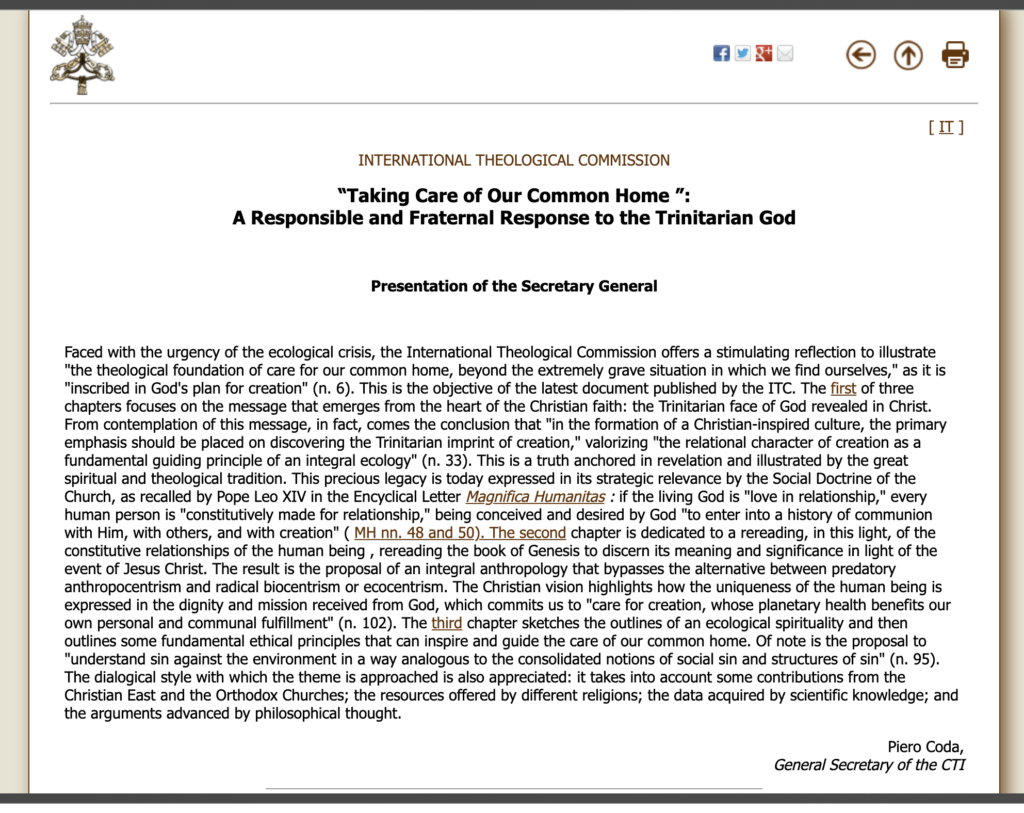
In yesterday’s DM and video, I praised the recent document from the Vatican International Theological Commission on “Taking Care of Our Common Home.” Here I offer some critique of the document. Overall, I would give it a B or B+.
What could be improved on?
First, by leading with a long theological discourse on the Trinity, it creates a context that is not at all welcoming to other religious traditions. Creation, after all, belongs to all of us, as does science that studies creation.
Why not begin with what we have in common and the work we need to accomplish together before time runs out for our species?
Instead, the document ends with that and begins with fourth-century “fathers” parsing dogmatic discussions about the Trinitarian mystery. While offering some insights and inspiration, an in-house theological discourse is hardly inviting to those of other traditions.
Also: Why isn’t this document officially translated into English? The current AI translation frequently makes no sense.
Thirdly, why call for an “ecological spirituality” when we already have a name for what is needed, a name bequeathed to us by the great Pére Chenu, OP, who named the “creation spirituality” tradition in the last class he ever taught.
The word “creation” is far larger than the word “ecological,” for it includes all 13.8 billion years of the cosmos, including but not limited to the 4.5 billion years of our Earth home. Creation made Earth possible and still does. When we gaze at the stars at night, we are gazing at an ancient sky. “Ecology is functional cosmology,” as Thomas Berry teaches. Begin with the whole, not the part.
Creation Spirituality is a living movement with a rich heritage already, a theological lineage, a pedagogy for re-learning mysticism and the sacredness of things and much more. Its current incarnation was developed by scientists and theologians working together in North America, including Thomas Berry, Brian Swimme, Rupert Sheldrake, indigenous teachers like Sister Jose Hobday and Lakota elders, and the martyred rainforest defender, Sr. Dorothy Stang. Not a single reference to any of them is among the many references in this document, and Teilhard de Chardin is mentioned only in a footnote.
Fourthly, it was Aquinas, not Bonaventure, who brought the most important scientist of the Middle Ages, Aristotle, into linking faith and science. Having the courage to break with Plato and Neo-Platonism, he paid a severe price, being condemned three times after he died. Science historian Michael Polanyi said Augustine “destroyed interest in science for 1000 years” in the West.
Aquinas said the cosmos began from God’s “sheer joy” that all creatures participate in the joy of existence and that “revelation comes in two books: Nature and the Bible.”
Fifthly, the entire document lacks any mention of the essential role of the divine feminine in eco-spirituality. Earth is called “Mother Earth” for a reason. Patriarchy and patriarchal theology obstruct a creation spirituality. According to Rosemary Ruether, dualism is the foundation of patriarchy. Dualism is Augustine saying, “spirit is whatever is not matter.” Non-dualism is Aquinas saying, “spirit is the elan and vitality in everything.”
Adrienne Rich names a second patriarchal foundation: “fatalistic self-hatred.” This is one reason beauty, joy, and gratitude for creation constitute the starting point, the Via Positiva, for a creation spirituality.

The section on spirituality is paper thin and ignores the four paths of CS even though Laudato Si is built on them.
Thank God there is only one reference to “original sin” in the entire document. As Elie Wiesel put it, “not only is original sin not in the Bible, it is alien to Jewish thinking.” Jesus never heard of original sin.
He did hear of original blessing/original goodness. Anyone acquainted with Genesis one knows this. Certainly humanity is flawed—but we improve by holding up the goodness of existence.
Banner Image: Ecology as cosmology, creation ongoing: “Mystic Mountain” in the Carina Nebula, with a three-light-year-tall pillar of gas and dust being pushed apart from without by light and winds from nearby stars and from within by jets of gas from infant stars. Photo by NASA, ESA, and M. Livio and the Hubble 20th Anniversary Team (STScI)
Queries for Contemplation
Do you agree that the return of the Divine Feminine and moving beyond patriarchal dualism and self-hatred is integral to an earth-based and creation spirituality? And that recognizing the “very goodness” of creation that Genesis One talks about is integral to inspiring and motivating humanity to care about it?
Related Readings by Matthew Fox
Original Blessing: A Primer in Creation Spirituality
The Tao of Thomas Aquinas: Fierce Wisdom for Hard Times
Sheer Joy: Conversations with Thomas Aquinas on Creation Spirituality
Passion for Creation: The Earth-Honoring Spirituality of Meister Eckhart
Creation Spirituality: Liberating Gifts for the Peoples of the Earth
Julian of Norwich: Wisdom in a Time of Pandemic—and Beyond
Matthew Fox and Rupert Sheldrake,The Physics of Angels: Exploring the Realm Where Science & Spirit Meet
Matthew Fox and Rupert Sheldrake, Natural Grace: Dialogues on creation, darkness, and the soul in spirituality and science
Western Spirituality: Historical Roots, Ecumenical Routes
Charles Burack, ed., Matthew Fox: Essential Writings on Creation Spirituality
Sins of the Spirit, Blessings of the Flesh: Transforming Evil in Soul & Society

8 thoughts on “Evaluating the ITC Document on Care for Our Common Home, Part II”
I don’t know about advocating for a Divine Feminine as such. I believe Natural Order will be restored when we have a far greater Cosmic Sense. It is a wonderful exercise to ask people how big the Milky Way would be if the solar system was the size of a quarter? Answers inevitably vary but almost everyone is shocked to learn that this galaxy would be the size of the United States! We are living upon a world the size of a quarter within a galaxy the size of the entire United States! Then point out that the sun is 99.6% of the mass of this quarter, and that Jupiter, Saturn, Neptune and Uranus are almost all of the remaining 0.4%; in other words 8.5 billion of us are living upon a pinprick on that quarter in the whole of the United States! And then point out that there are billions of galaxies! It’s all an utter marvel. I believe humanity needs this Cosmic Appreciation to take hold. The rest will then follow.
To Augustine saying, “Spirit is whatever is not matter,” we may reply that Spirit blows where it wants, including in the heart of matter, and what he thinks about it does not matter. The Church’s original sin is Augustine’s invention of original sin, a desecration of matter completed twelve centuries later by Descartes.
It is so painful to hear the prophetic voice of Thomas Berry still ignored in decision circles, especially in key documents issued by the Vatican about the relationship between the human community and the Earth’s community. By the way, if a publisher is interested in a French translation of Thomas Berry’s The Great Work and Evening Thoughts, I have one ready.
YES! YES! Our healthy spiritual journeys very much depend on Our awareness/consciousness of Our personal and communal Sacred Loving Diverse Oneness with Sacred Living Beautiful Mother Earth/Her living creatures/Her graceful abundance, including All physical/non-physical
spiritual dimensions/Beings, in Our Sacred Evolving Co-Creation Cosmos in the Sacred Process of the Eternal Present Moment….
BRAVO!!
Father Gilbert Hemauer served as a pivotal leader of the Tekakwitha Conference at its origins and was the Conference’s Executive Director from 1977 to 1989, often spoke on the integration of Native spirituality with Catholicism. In his teachings, he explored the Lakota concept of wahkon, describing it not merely as “sacred” but as a comprehensive worldview of the Great Mystery that permeates all of creation.
A new article of mine is titled: The Catholic Church’s Coming One World Religion
It is subtitled: A One World Religion With A Worldview Around The Native Word Wahkon
It is located a thttps://www.towahkon.org/HippyOneWorldReligion.html
The language that the Catholic Church is now using, like “listening to the cry of Mother Earth,” an “ecological conversion” and “a sin against creation and the Creator” is believed by traditionalist Catholics to be conditioning multitudes of Catholics to be eventually enabled to accept the replacement of the long standing core dogma that denies the existence of a living, conscious and communicative Mother Earth with a doctrine that teaches that Mother Earth literally does exist. I believe that this long standing “core dogma” is the source cause of the current global
When Laudato Si came out and I regularly attended RC mass it was almost never preached from the pulpit. My impression from studies I’ve seen is most Catholics in the U.S. are aligned with right wing conservatism and today that means they mostly don’t care about these concerns.
Despite the wisdom in Matthew Fox, spiritually means
something very different to them i.e. correct doctrine and dogma.
Little else is significant to them it seems.
Will that ever change? Thomas doubted I recall.
Beyond simply the return of the divine feminine, I believe we need a sacred union between the feminine and the masculine in order to move forward. One way this manifests is in the rise of trans and non-binary folks.
We’ve got it upside down. Instead of using the lens of patriarchal dualism to demonize and ostracize and scapegoat these people, we should be looking towards them for spiritual guidance, and as a sign of evolution, a sign of union between masculine and feminine.
We should be rejecting dogma and embracing spirituality as accessible to all, and not contingent upon saying the right words in the right order like a spell, or kneeling or standing at the right times. We are all of us perfectly made and we are not broken. That does not mean there isn’t work to be done – evolution and growth happen – but I agree that it starts from a place of innate goodness.
As for as how to motivate people to care – that one is a mystery to me and I have no insights or intuitions, other than to BE love, to BE the light, and to metabolize dark energy into light when possible, with hopes that changing the energetic field we live in will also change the people living in it.
Someone asked yesterday if this official edict has made its way into the pulpits, and I am curious about that too. What’s the efficacy of a document like this if it’s not practically applied?
YES!!!