
I have promised to rectify the understanding of the Cathars that I presented recently while writing about Hildegard’s preaching against them (DM August 31).
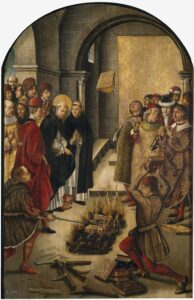
In the past twenty years, there has been a flurry of historical research on the Cathars. Some claim that Catharism has never existed except as an enduring invention of late 19th-century scholars of religion. Others underline instead the proven historical links between Cathars in the West and the Bogomils of the Eastern Roman Empire, defined as Christian dualists who adopted an ascetic lifestyle, rejecting sexual intercourse completely, and abstaining from meat and wine.
One historian who attempts to reconcile those two extremes, states that it was only in a late stage — that is, in Languedoc, from the end of the first quarter of the thirteenth century onward — that the Church’s intransigence and persecution made certain dissidents sway toward a dualistic Christianity that portrayed the entire material world as the work of the cunning devil.
There were many groups of dissidents in Europe between the 12th and the 14th centuries who criticized the corruption of the clergy and quoted the Gospel against them. Under the collective label of “boni homines” (i.e. good people), we find all sorts of lay preachers, and even renegade priests, who joined movements soon suspected of heresy.
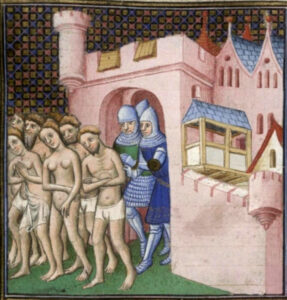
The call to the Apostolic Life of poverty, humility, and trust in God’s providence was heard far and wide. In some cases, it led people to denounce the Catholic bishops and refuse their rituals and sacraments, while in other cases it issued into Mendicant Orders — most notably Dominicans and Franciscans — which fought “heretics” with their same weapons, that is, by living an exemplary Christian life.
A crusade was called by the pope in Southern France. On July 22, 1209 the massacre of Béziers took place. The town was accused of sheltering heretics, but was promised clemency if the town handed them over. A list of about 200 “heretics” was compiled, but ultimately the town decided not to betray their fellow citizens, thus effectively signing their own death sentence. About 20.000 people were slaughtered at once.
This astonishing massacre happened on the feast-day of Saint Mary Magdalene, although the connection between Cathars and the Gospel of Mary is a late 20th-century fabrication. It is likely that Cathars gave to women the same level of authority as men, and that they considered Mary Magdalene equal to the apostles. However, this was not exclusive of them. Waldensians — another dissident group — also gave to women the authority of preaching and celebrating the Eucharist, and the title equal to the apostles is given to Mary Madgalene by the whole Eastern Orthodox Church. If anything, this confirms the link between Eastern dualism — often preached by Bogomils disguised as Orthodox monks — and Western dissidents/heretics.
Why does any of this matter today? Cathars are becoming a kind of catalyst for many of our needs and projections. They are perfect candidates for a number of reasons. They are mysterious — virtually there is no extant document written by a self-awoved Cathar — so one can project on them almost anything. They seem to be forerunners of spiritual democracy as they rejected Church hierarchies and elevated women. They embody the perfectly innocent victim — even their Catholic contemporaries raised high laments about the tragic Béziers events.
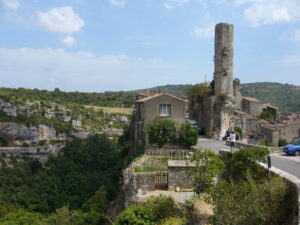
None of this allows us to disregard the many sources regarding the dualism embraced by Cathars. The psychological tendency to elevate oneself beyond matter and call it spiritual life is present in all eras. Creation Spirituality fights against this, just as Hildegard and the early Dominicans and Franciscans did.
Hildegard, Dominic, and Francis never condoned violence, even though some of their followers did. They were sometimes suspected of heresy. But they did always celebrate the beauty and energy of the material creation. Others did not. The latter are interesting, and their tragic end is deeply moving, but they are not my heroes.
Antonio Sennis, ed. Cathars in Question. York Medieval Press, 2018, p. 21 (Mark Gregory Pegg), p. 131 (Bernard Hamilton), and p. 81 (Julien Théry-Astruc).
Banner Image: “The Crusaders and the Capture of Béziers,” from The History of France in 100 Tableaux by Paul Lehugeur, 1800. Wikimedia Commons.
Queries for Contemplation
Did you encounter Catharism in your studies or spiritual search? What inspires or interests you about them?
Related Readings by Matthew Fox
Hildegard of Bingen: A Saint for Our Times.
Hildegard of Bingen’s Book of Divine Works.
Illuminations of Hildegard of Bingen.
Sins of the Spirit, Blessings of the Flesh: Transforming Evil in Soul and Society.
The Pope’s War: Why Ratzinger’ s Secret Crusade Has Imperiled the Church and How It Can Be Saved.
Original Blessing: A Primer in Creation Spirituality.
Creation Spirituality: Liberating Gifts for the Peoples of the Earth.
Charles Burack, ed., Matthew Fox: Essential Writings on Creation Spirituality.


.jpg)

5 thoughts on “Cathars Today”
“Do not judge, so that you will not be judged” is a harmonic of the Golden rule. Passing judgment on events that took place centuries ago while applying today’s worldviews does not make much sense, and yet we do it regularly. I am nevertheless deeply troubled by the slaughters of the past and especially horrified when they are perpetrated in the name of the Prince of Peace. It is hard enough to be aware that 130 armed conflicts, including ethnic cleansing and genocide, plus ecocide, plus geocide are taking place in our times. Feeling powerless can be unbearable, and I often have to remind myself of the hummingbird story as told by Wangarĩ Maathai (2004 Nobel Peace Prize). https://www.youtube.com/watch?v=nOPiJTBAr1Y
Didn’t know about them. Interesting early spiritual movement critical of the corruption of the church institution with its patriarchal values, which in many ways are still prevalent today.
Thank you Gianluigi for researching the Cathars in more depth and providing this balanced exploration of their beliefs and the horrific genocide perpetrated against them by the church and government of the times. As a psychotherapist, I find movements that favor dualistic perspectives separating the earthly from the spiritual realm to represent a possible symptom of extreme trauma, often following periods of exclusion and/or persecution. The Puritans in American history might be another example of this phenomenon. I am so grateful to Meister Eckhart, the Beguines, and Hildegard of Bingen, along with other mystics, who showed us how to balance blessing with brokenness, compassion with justice despite persecution and suffering. It is interesting to note that Hildegard was sent to a convent monastery as a child, where she was walled up in a small hermitage for many years. Despite what we might term childhood abuse in this day and age, it was in this place that she began to witness the visions that became the cornerstone of her later spiritual teachings. Grace is so powerful, even in the worst of circumstances, yet never abnegates the prophetic call to intervene when injustice and evil are present.
I truly appreciate the history and dedication of Matthew andGG that is in these messages every day. I learn and am blessed by this every day.These teachers and messages are vital to my spiritual journey and life. Thank you
I have never heard of the Cathars, so thanks for sharing a bit about them. After reading this, I’m left pondering how the disconnect with “material creation” laid the foundation for our current climate situation. Also how odd it is to me that folks could feel spiritually complete without a deep love of the Earth and all beings, and the rest of the cosmos. I’d like to think more about that.
I’m also thinking about how we always have religious factions fighting with each other – each convinced their view is the one true system, and that all others must be purged, or at least considered less than. This seems innate to humans, the root of 99% of our problems, and I don’t know that we will ever overcome it.