
When Eckhart says he “prays God to rid me of God,” he is emphasizing the apophatic divinity, the “God without a name who will never be given a name.” Holding up the apophatic divinity holds political consequences. It gives us permission—as it did to peasants in Eckhart’s day—to critique those powers that claim to speak in God’s name.

Eckhart does not confuse the church with the kingdom of God. He also rejects subject/object relationships with divinity in favor of what I would call a political panentheism. Or democracy. He is central in my chapter on “Jesus and Democracy” in my recent book on the Antichrist.
Marx talked about changing the world rather than gazing at it. For Eckhart, contemplation is a “participating in” being and not a “gazing at” being. As Reiner Schurmann puts it, he seeks a “practical guide to what we must become.” He invites all to give birth, to beget, to create, to change and be changed. Like Marx, he is action-oriented. “We are all meant to be mothers of God, for God is always needing to be born.” His Via Creativa leads to the Via Transformativa.
Eckhart paid an ultimate price for his commitment to justice when he was condemned a week after he died and much of his work went underground for centuries. But scholars agree that it was a political condemnation typical of what prophets regularly undergo, which Jesus warned about in his Beatitudes.
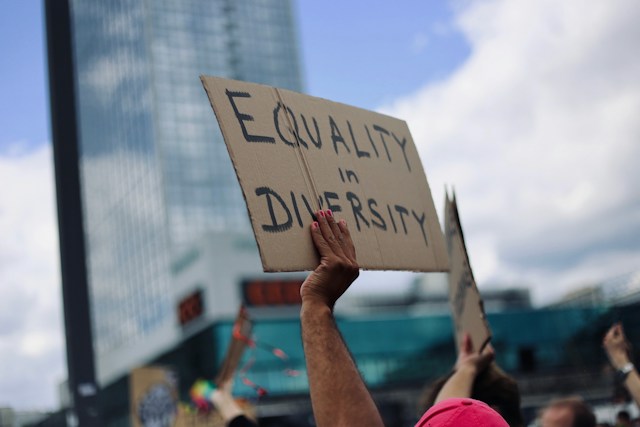
Eckhart says that we need to “practice equality in human society.” Since then Christ’s whole nobility belongs equally to us all and is equally near to us, to him as much as to me . . . you must understand that, if someone wants to come by this gift equally to receive this good and the common nature which is equally near to all people, you must needs practice the same equality in human society, being no nearer to yourself than to another, just as in human nature there is nothing alien, nothing farther or nearer.
If we are brothers and sisters in one God, then we are all equals. This is the springboard for compassion. Eckhart advises: You are to love, esteem, and consider all people like yourself; what happens to another, be it bad or good, should be for you as if it happened to you. All love demands equality. Love will never be anything else than there where equality and unity are. Between a master and his servant there is no peace because there is no real equality. Peace and tranquility among people demand their equality.

For Eckhart, the same holds for personal relations and for marriage. “A wife and a husband are not alike, but in love they are equal.” Where equality is lacking, we are to bring it forth. “There can be no love where love does not find equality or does not create equality.” Societal leadership is of the same ilk. If I were to lead people, they would never follow me with pleasure if they did not receive equality with me. For a movement or a deed is never accomplished with pleasure in the absence of equality.
Thus Eckhart, writing 450 years before Thomas Jefferson, has a far broader understanding of democracy than he did. Eckhart does not limit the dignity of personhood to white people or men or men with property, as did Jefferson in practice if not on paper. For Eckhart, we are born noble—all of us—and it is from that royalty that our rights derive, and we in turn are urged to treat others as ourselves and live “equally.” In Eckhart’s view, based on the teachings of Jesus, “there can be no love where love does not find equality or does not create equality.”*
* See Matthew Fox, Passion for Creation: The Earth-Honoring Spirituality of Meister Eckhart, pp. 522-530.
Banner image: “One for all, all for one.” Diversity, maPhoto by Rineshkumar Ghirao on Unsplash
Queries for Contemplation
Do you agree with Eckhart that equality and love go together and that “love will never be anything else than there where equality and unity are”? What are the implications of that teaching for a renewed democracy? And a healthy economics? And politics?
Related Reading by Matthew Fox
“Jesus and Democracy,” in Fox, Trump and the MAGA Movement as Anti-Christ: Recognizing the Archetype of Evil in Our Time, pp. 63-70.
Meister Eckhart: A Mystic-Warrior For Our Times.
Meditations with Meister Eckhart: A Centering Book, pp. 89-131.
“Meister Eckhart and Karl Marx: The Mystic as Political Theologian,” in Fox, Wrestling with the Prophets: Essays on Creation Spirituality and Everyday Life, pp. 165-198.
Original Blessing: A Primer in Creation Spirituality
Creation Spirituality: Liberating Gifts for the Peoples of the Earth.
A Spirituality Named Compassion: Uniting Mystical Awareness with Social Justice
Creativity: Where the Divine and the Human Meet.
Charles Burack, ed., Matthew Fox: Essential Writings on Creation Spirituality.
Adam Bucko and Matthew Fox, Occupy Spirituality: A Radical Vision for a New Generation.
Sins of the Spirit, Blessings of the Flesh: Transforming Evil in Soul and Society.
The Pope’s War: Why Ratzinger’ s Secret Crusade Has Imperiled the Church and How It Can Be Saved.


4 thoughts on “Eckhart on Equality, Democracy, Mysticism & Justice”
When I reflect on the meaning of “equality” I am quickly caught in an endless loop unless the domain to which equality applies is specified, like “equality of rights,” “equality of responsibility,” “equality before the law,” etc. Equality and humility are lousy roommates because equality implies comparison while humility excludes comparison.
In the village where I grew up, a large wrought iron sign above the gate of the cemetery read, “The Field of Equality.” It could as well have read “The Field of Humility”: all tombstones were not equal, but in humus, humans who might have forgotten their roots when they were alive were at last humble and equal at the same time.
I find it difficult, if not impossible, to have this conversation without a recognition of Karma; an understanding of equality as a natural all-pervasive Law. In the pure sense, I agree with Eckhart, but we are not all equal in the material sense and I question and partly disagree with “The Field of Equality” for reasons of karma, not death. I would not want Marx’ sense of material equality; nor do I believe it can work. We are all equal in divine potential and our time here on Earth is to evolve. I believe that process is through Love and Service so, if it is to have political ramifications – and it should, the greatest in material wealth and wisdom would use these attributes which they have rightfully gained to relieve suffering and uplift all humanity. The ancient motto of the Prince of Wales, heir to the English throne, is “Ich Dien”, I Serve. Such chivalrous virtue needs to be restored.
I think before we can talk about renewing anything we need to do something about capitalism, which in my mind is the root of our problems. It creates inequality and injustice by design. At the very least it needs to be very heavily regulated, and at best completely abolished.
Earth is abundant and it’s possible for us all to have enough. But first we need to embrace and embody the teachings of the many prophets that have come before us, and the ones with us today. Unfortunately capitalism prevents us from doing so. How can we live in justice and love when our systems are designed to oppress and separate us? It’s a problem I don’t know how to solve.
We have collectively made choices that have created our current world. We need to make different ones to bring about changes. I believe this starts with each of us in our daily lives. Each choice a snowflake – and with enough of them you get an avalanche. It can be as simple as watching your thoughts, choosing love, embracing hope, cultivating empathy. We are all waves on the same ocean. We are one.
Yes! ‘Being & Becoming the Divine Flow of Loving Diverse Oneness in the Sacred Process of the Eternal Present Moment… ‘ is one of my important spiritual mantras/prayers.