
Even though she was an abbess, not a simple nun, Hildegard of Bingen (1098 – 1179) had to be very careful when she, as a woman, started claiming visions that connected her directly to God and resulted in quite a copious outpouring of writings spanning from theology to psychology, from theater plays to medicine.

We don’t know much about the backstage work of personal contacts that she must have carefully devised to get written approval of her first book by Bernard of Clairvaux. Once that was obtained, however, she felt secure enough to go on with her life and production.
It’s interesting to observe that in her letter to Bernard she calls herself a wretched person, and even more a wretched woman who has studied no theology and knows no Latin. Yet she claims that she received her visions in Latin, and she shows a quite deep knowledge of the Bible and theology in the book itself — written, of course, in Latin — that she had someone deliver into Bernard’s hands. Even more, on the very first page of such a book, which recounts her visions in great detail, she is addressed by the divine voice as a human being. Not a gendered individual, but a representative of the human species as a whole, replete with a dignity that jumps out from the page.
As a theologian of the 12th century — and even more the only recognizable female theologian of her era — Hildegard could not confront the dogma of original sin directly. The ideas of Augustine of Hippo (354 – 430) were still the basis of Catholic orthodoxy in Western Europe. She probably did not even fancy criticizing Augustine. Yet she turned the doctrine of original sin on its head, simply by infusing it with her spiritual experience.
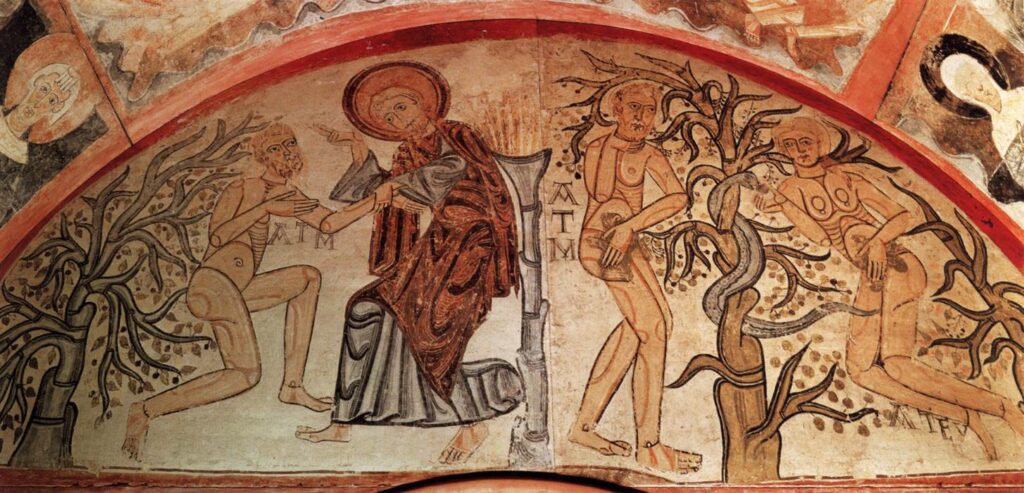
Augustine’s pessimism, which so heavily covers his late writings, is nowhere to be found in Hildegard. She is still very aware of the power of evil, but she also wants to give humanity all the possible weapons to fight it. One has the constant impression, while reading her writings, that the Edenic state can not only be recovered in the afterlife, but can be approximated to quite a great extent even in this very bodily life.
Hildegard’s description of the fall of humanity — she talks of Adam as its symbol and progenitor — is found in several of her writings, but the most interesting to me are the medical ones, where her focus is on recovering the fullness of the psycho-physical integrity of people. Her general diagnosis with regard to humanity is that in the Edenic state people live in perfect harmony of body and soul, their health being stunning: they smell deliciously, their intuition is very keen, and their spleen produces a clear substance.
Ignotus Amicus
But their breaking up with God brought about chaos in their minds and their bodies. Sad thoughts became prevalent, stagnant mucus produced bad smells and bad functioning of organs, and the spleen started producing a bitter fluid, which is the cause of melancholy and wrath. This mutation, however, can be reversed through the appropriate methods, which include awareness of one’s thoughts, respect of the natural rhythms of one’s body and nature, diet and herbs and stones which can cure not just any specific illness, but most especially all the specific human types in which the perversion of the original human state has issued.*
Hildegard, of course, was aware that the redemption wrought by Jesus Christ, and the sacraments of the Church which communicate such redemption to the believers, are the main channels for the restoration of people to their Edenic state. Just as Augustine said, and the Church confirmed. But what about her medical writings then?

A naughty reading would have that, for her, the redemption and the sacraments are not enough. Without proper care of one’s body, they fail. A less naughty reading would state that all of nature to her is a sacrament, that is, the presence of God within matter.
Either way, her theology of restoration and wholeness, starting from Augustinian premises, ends up in a very different place. One in which one’s continual care for one’s emotional and physical balance is not only not egocentric and not sinful, but is an instrument in God’s hands for reaching the full stature of our potential as human beings. This is God’s will, in Hildegard’s understanding.
Hildegard’s literal reading of the Fall as an historical, archaic event is, of course, untenable. Her insistence on talking about Adam as the main culprit, rather than Eve, is surely formidable in her age. The challenge that her interpretation posed to centuries of ascetic Augustinian-flavored spirituality seems to me still far from being fully appreciated.
Giovanni Giambalvo Dal Ben, Ildegarda, l’arte della cura, in Dal Ben & Pereira (eds.), Le Vie di Ildegarda. Saperi, contemplazione, cura, Gabrielli 2020.
Banner Image: Sculpture of Hildegard of Bingen by Karlheinz Oswald, 1998, in front of Eibingen Abbey. Photo by Gerda Arendt, on Wikimedia Commons.
Queries for Contemplation
Do you think of your self-care as a spiritual activity?
Related Readings by Matthew Fox
Hildegard of Bingen, A Saint for Our Times: Unleashing Her Power in the 21st Century, p. 30
Illuminations of Hildegard of Bingen
Hildegard of Bingen’s Book of Divine Works: With Letters & Songs
Gabriele Uhlein, Meditations with Hildegard of Bingen, Preface by Matthew Fox.


6 thoughts on “Hildegard as a Theologian”
I take self-care as a spiritual activity only if the self is understood as a spiritual being. If it is not, self-care is auto-care, another name for car maintenance: it may increase potential mileage and the shiny body may impress onlookers, but a scrapyard or at best a museum collection is the final destination.
Walt Whitman knew that when he wrote in “Song of myself” (a title that should not be confused with the narcissist utterance of an auto-care aficionado):
“I believe a leaf of grass is no less than the journey-work of the stars,
And the pismire is equally perfect, and a grain of sand, and the egg of the wren,
And the tree-toad is a chef-d’oeuvre for the highest,
And the running blackberry would adorn the parlors of heaven,
And the narrowest hinge in my hand puts to scorn all machinery,
And the cow crunching with depress’d head surpasses any statue,
And a mouse is miracle enough to stagger sextillions of infidels.
I find I incorporate gneiss, coal, long-threaded moss, fruits, grains, esculent roots,
And am stucco’d with quadrupeds and birds all over,
And have distanced what is behind me for good reasons,
But call any thing back again when I desire it” […]
Wonderful to see this Whitman quote! I have been tossing in my mind these past few days, the line “Have you reckon’d a thousand acres much?” It’s so imaginative and whimsical.
“Have you felt so proud to get at the meaning of poems?
Stop this day and night with me and you shall possess the origin of all poems,
You shall possess the good of the earth and sun, (there are millions of suns left,)
You shall no longer take things at second or third hand, nor look through the eyes of the dead, nor feed on the spectres in books,
You shall not look through my eyes either, nor take things from me,
You shall listen to all sides and filter them from your self.” Walt Whitman, The Song of Myself.
Yes. Our healthy and transformative spiritual journeys are intimately related to wholistically and Faithfully taking care of our bodies/Souls and Loving interconnections with Sacred Mother Nature/Her living creatures/Graceful abundance, and the Divine Flow of Loving Diverse Oneness within and among Us in All of Co-Creation/Sacred Evolving Cosmos, including All physical/non-physical spiritual dimensions/Beings, in the Sacred Process of the Eternal Present Moment….
I am finding myself increasingly mindful of everything as a spiritual activity. I’m learning to use every moment as an opportunity to feel unified and not separate. It’s so easy to mindlessly brush my teeth, but it is also possible to use that time to feel my deep connection to all that is. The same can be said when eating, exercising, doing laundry, washing dishes, clipping my toenails, taking a shower…
Of course, my morning meditation is self-care, and deeply spiritual. But really everything is spirit, there is nothing that is not spirit, and I am learning to be present with that truth in every moment.
Recently your DM made the distinction between “sacred and desecrated” more truthful than “sacred and profane,” a more conventional (and dualistic) antithesis. This very positive phrase lines up inspiringly with Jesus’s words, “I am always with you” and “I am the vine, you are the branches.” These touchstones apply to us all, including us who defy them in sin. Our human-caused suffering can be stopped before our lives end. It hasn’t happened to many yet, but with Christ it’s possible.