
I would like to explore some more the topic of healing from trauma and how that relates to spirituality. For quite some time I resisted the notion that we all have some trauma to heal, as it seemed to imply that all social issues can be understood through a medical paradigm.
On the contrary, I believe that social and personal issues are too often inappropriately treated as medical problems. Yet I believe that we all have some fundamental trauma to heal and that the individual and collective process of trauma healing is the main road for our species to thrive. The road to healing must be spiritual, meaning that it must include specific attention to both our body and our psyche, yet transcend our bodymind into a higher unity or communion with the divine.
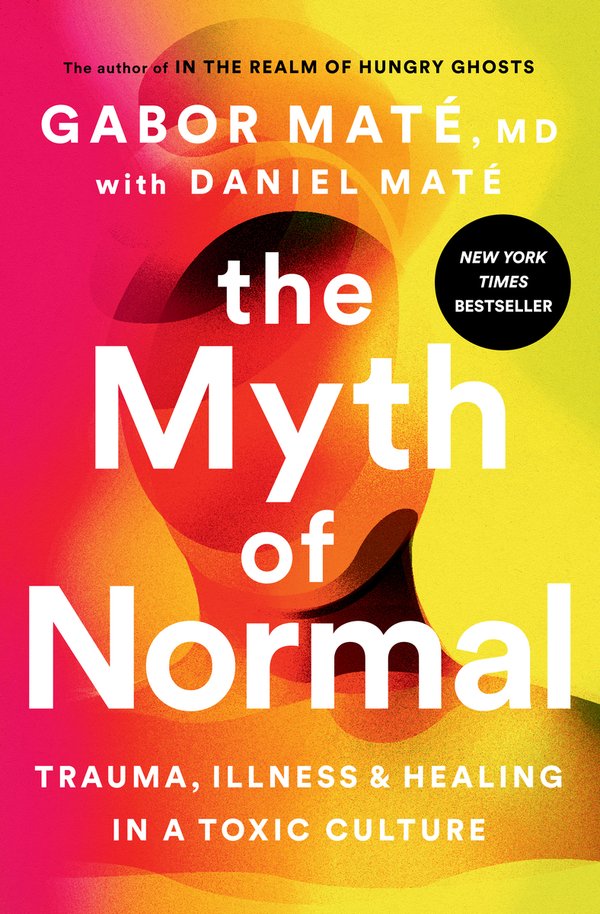
Gabor Maté — a medical doctor who has spent his entire career helping people heal from trauma — describes with incredible accuracy the main obstacles to trauma healing: crippling guilt; self-loathing and its close cousins, self-rejection, self-sabotage, and self-destructive impulses; and blocks in our emotional memory.
Maté has coined an expression for these complexes made of emotions and deep convictions. He calls them our stupid friends. He says that we need not fear, avoid, reject, or suppress these “undesirables”; in fact, we merely delay our emancipation from them when we do.
Maté teaches that our stupid friends seldom rise to consciousness in everyday life. One can live with pain, fatigue, dissatisfaction, and other symptoms, for a very long time without knowing anything about hosting these ugly things inside. Even existential guilt, the bone-deep guilt that makes a person feel culpable for even being here, is something that you may live with without knowing. It predates language and conscious awareness.
It is an utter shock to recognize any of these inside oneself, but it is also the beginning of the healing path. I know by experience. The next step is finding out the original traumas which gave birth to them. Stopping the blame must follow. It is natural that, at this point, one starts blaming the people or the circumstances which caused the traumas in the first place. Alternatively, one blames oneself. But this stage must be overcome if one wants to move toward wholeness.
Maté has worked for most of his life with Western medicine — showing both its potential and its blank spots — as well as with neuroscience and psychology. He is a truly modern man who did not care at all about spirituality, yet by pushing the boundaries of the disciplines he worked in and remaining devoted to healing his patients, he discovered the unexpected.
Today, Maté quotes Leslie Marmon Silko, saying: The only cure I know is a good ceremony. This sentence aligns very much with Creation Spirituality, and especially with our work on ritual, which puts us at odds with modern forms of religion — including much progressive Christianity which is captive of intellectualism and words printed on the order of service.
Maté’s description of his recent experiences with ritual and shamans — amounting to his conversion to spirituality — is touching, disarmingly innocent, and even funny. It is interesting to me, however, that his new phase in life does not coincide with an overcoming of psychological techniques. We simply need all the help we can get.
We cannot claim that the stupid friends are not inside us and have never been there — at least if we are Westerners. Again, they live below the level of consciousness and have been nourished for a long time by a series of cultural circumstances, including bad religion. Ritual, discoursive meditation such as this one, silent meditation, psychology, dance, spiritual counseling, plant medicine as well as Western medicine, all can collaborate in the process of healing which we badly need individually and collectively.
Banner Image: Street children, India. Photo by SwapnIl Dwivedi on Unsplash
Queries for Contemplation
Have you found yourself lamenting about your traumas? How were you able to get beyond such a stage?
Related Readings by Matthew Fox
A Spirituality Named Compassion: Uniting Mystical Awareness with Social Justice
The Beloved Will Guide You: St. John of the Cross and the Triple Dark Night of Our Times
A Way to God: Thomas Merton’s Creation Spirituality Journey
Meister Eckhart: A Mystic Warrior for Our Time
Charles Burack, ed., Matthew Fox: Essential Writings on Creation Spirituality
Hildegard of Bingen, A Saint for Our Times: Unleashing Her Power in the 21st Century
Creativity: Where the Divine and Human Meet
Natural Grace: Dialogues on creation, darkness, and the soul in spirituality and science

7 thoughts on “Healing from Trauma”
Thank you so much, GG, for this beautiful meditation on the great work of Gabor Mate. I am currently participating in his team taught H.E.A.L 90-Day program, available through MENTORSHOW on YouTube by subscription. One can join MentorShow at any time and find great healing in their healing Master Classes, taught by the best of the best teachers. Your meditation is very timely and will open a new conscious frontier in spiritual healing for many. Many thanks. Timothy O’Donoghue, County Donegal, Northwest Ireland
What a wonderful page to meditate on, today. My first thought, as I read “I believe that we all have some fundamental trauma to heal and that the individual and collective process of trauma healing is the main road for our species to thrive,” was that if the words “some fundamental trauma” are replaced with “some fundamental tear in our psyche,” that sentence is as close as it gets to a statement about an original sin, i.e. some form of “missing the mark” or “being off-center,” like a warped wheel or a joint dislocation, the exact meaning of “dukka” in the first noble truth of Buddhism. And when I listened to Gabor Maté’s account of his ayahuasca retreat and experience, I was struck with the word for word correspondence between what he describes and what I experienced in the 1990s while doing holotropic breath work with Stan and Christina Grof. On that basis, I am inclined to reconsider the skepticism I expressed yesterday about “Otto Rank’s daring assertion that birth itself is a trauma.” After all, the whole ball of wax about the theology of the Fall, the lost garden, and original sin, may be a projection of the expulsion from “paradise,” a personal birth trauma that is repeated on a collective scale by the Anthropocene expulsion from the womb of Mother Earth. Humanity needs to take a deep breath (or two) to rediscover its original blessing…
Dear GG,
This is-I realize with some sense of deep alignment-is the path that has called me my entire life. You may be interested in looking at the work of Thomas Huebl where he brings together mysticism and science. I suggest his book HEALING COLLECTIVE TRAUMA. He is Austrian by birth and not lives in Israel.
Peace and Every Good,
Chris
I’m not consciously aware of all my traumas, but I’ve been sensitively compassionately aware of suffering in humanity, historically and in current times. This awareness began around age nineteen with my own loss of innocence by becoming aware of my own mysterious personal suffering (no conscious awareness of any particular causative trauma or event). This interrelated awareness of personal and universal human suffering became the beginning of my adult spiritual journey of search for healing and meaning with many life experiences and transformations up to the present time. An important part of my continued healing and development of meaning has been the development of Faith in Our Eternal Souls, Our Loving Diverse ONENESS, and an Eternal Spiritual Dimension that Is part of Our earthly life, All physical/nonphysical spiritual dimensions/Beings, and Our Sacred Evolving Cosmos in the Sacred Process of the Eternal Present Moment… Recently I’m also developing more understanding and experiences of Our nonphysical subtle spiritual realms and beings within and around Us by my experiential study of Incarnational Spirituality (lorian.org) and Shamanism (shamanism.org).
Lately, when a personal trauma reaches my conscious mind, I simply acknowledge it and ask for grace to navigate through what’s in front of me. I’ve found that when I do this I can literally feel the energy and power of the trauma dissipate.
As a result of my cancer diagnosis and then my awakening this summer, I have found myself fully embracing the present moment. So much energy from the past and future just doesn’t penetrate any more. I am here now. That’s it. I really think this helps mitigate the lurking traumas, because there just isn’t space for them.
But there is breakthrough trauma – occasionally I’ll find myself reacting to a situation in an unexpected way, and I try to reflect on such moments when I can to discern the source. Often I can clear it, or at least clear it enough to move on. I think some trauma is permanent and we just learn to live with it.
The more I can stay in a space of love and connection to all, the less trauma impacts me. Sometimes when I’m in the woods I’ll see a tree that has a severe deformity in its growth and I think, wow, that tree has been through some stuff — but look, it grew anyway! The deformity is still there, but the tree is strong and tall.
I just wish to add the important role that nuns have played as spiritual directors alongside the traditional priestly role of counseling. Sr. Anne Chester, IHM (Immaculate Heart of Mary) traveled the world in the 2000’s helping to establish the House of Prayer movement. My friends and I benefited greatly from opportunities to immerse ourselves in contemplative practice while receiving support from a mentor figure. These women, like the Nuns on the Bus, have also been a visible force for justice in the world while often being the object of Vatican strictures.
Thank you very much for this comment, Marijo. In fact, it is not only historical female figures like Hildegard or Julian of Norwich who performed the role of “spiritual director” but many nuns and other wise women did and do it all the time, in official, semi-official, or completely non-official capacities.