
Perhaps one of the least-known aspects of Hildegard of Bingen’s thought is her passion for gems and their healing properties. She numbers twenty-six precious stones and their properties, which she calls subtilitates, just like the properties of plants, and which in both cases — minerals and plants — are conceivable as the deliverable aspect of their viriditas or vitality.
Hildegard perceives all of nature as alive and full of divine energy, not just plants and animals. The four main winds, blowing from the four corners of the earth — as she put it, meaning the four directions — are the main vitalizing forces in her cosmology. She calls them wings of God’s power.
In her view, the winds help the firmament stay firm, which is yet another indication of how she understands the cosmos. Stability for her is a product of interactions, so the sky is not a fixed and immutable thing like a stone arch, but rather a breathing balloon. Yet even this metaphor of the stone arch does not work very well, because for her even stones are alive.
The Earth is Gaia, we would say today. Hildegard knew it already about 850 years ago. This is the interpretative context for trying to make sense of her theory of stones as healing, magical objects.
Only in one case, Hildegard suggests grinding a stone and taking it in small doses with a beverage. This is beryl, which she suggests taking only to counteract the effects of poisoning. In most cases, she believed that the healing effects could be had by contact of the stone with the skin.
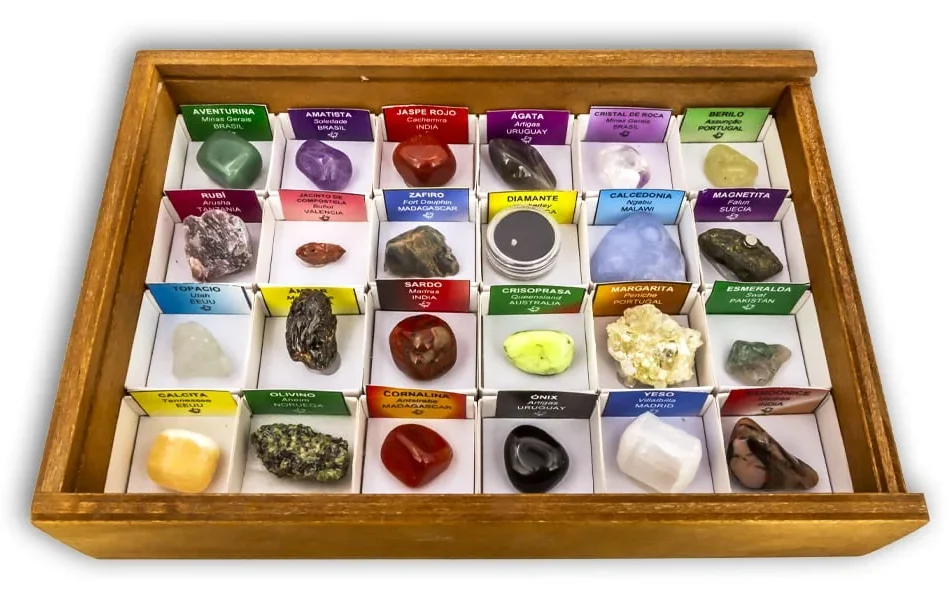
Not surprisingly, her favorite gem is the green emerald, which she believes to be a sort of hyper-concentrate of viriditas (greenness). Then the topaz, which is good for the eyes as well as for keeping a stable virtue, and the sapphire to keep away evil spirits. For most physical/mental/spiritual illnesses, there is a stone which can help.
It seems quite absurd to apply Hildegard’s understanding of stones literally, starting with the fact that beryl is actually very toxic to the human organism. Yet Dr. Giovanni Giambalvo Dal Ben offers a scientific hypothesis on why Hildegard might not have been wrong in principle, that is, on the notion that stones can have curative power.*
Contemporary science holds that stones can interact with the human organism only through the emission and reception of photons. Gemologists make regular use of the measurement of the wavelengths of photon absorption by gems; they actually use this method to establish the authenticity of every single gem.
Recent research also suggests that living organisms can emit photons, even though the origin of the emission within the organism is unclear. Dal Ben suggests that if the emission came from the nuclear DNA of the cells of living organisms, such photons could then be absorbed by specific gems, thus hypothetically bringing back to balance certain bodily imbalances.
While this remains a hypothesis, it is utterly fascinating. It speaks once again of a post-modern way of looking at the cosmos, which is such an integral part of Creation Spirituality. With such a change of outlook on the world, even other portions of Hildegard’s reasoning on stones begin to make sense and resonate with contemporary science.
Her idea that the gems were made on the first day of creation resonates with the notion that the elements of our periodic table were concocted in the original crucible of 13.5 billion years ago; her idea that stones keep the “memory” of the chemical events that brought them to existence in the stable form we encounter now is less far-fetched than we thought before.

Most interestingly, stones for Hildegard are keys to the soul, in a way that mixes indistinguishably their physical power with their symbolic meaning. Dal Ben writes that, for Hildegard, stones act like mediums between the macrocosm and the microcosm, as amplifiers and accumulators of cosmic energies… they represent keys capable of unblocking secluded zones and specific dynamics of the soul.*
Dal Ben continues: as they recognize in each other the same divine matrix, stones and souls activate within the organism the strength and mechanisms necessary to sustain the power of self-healing, the power of viriditas, thereby favoring the recovery of the lost harmony made of physical, psychological, and spiritual vibrations.
Even though I am skeptical of crystal therapy, immersing myself in this aspect of Hildegard’s teaching made me more aware of how little I know about health, and how much her integral vision of the curative power of nature is needed today.
*Giovanni Giambalvo Dal Ben, Ildegarda, l’arte della cura, in Dal Ben & Pereira (eds.), Le Vie di Ildegarda. Saperi, contemplazione, cura, Gabrielli 2020.
Banner Image: Rough emerald crystals from Panjshir Valley, Afghanistan. Photo by Paweł Maliszczak on Wikimedia Commons.
Queries for Contemplation
What is your relationship with stones in general? Do they yield spiritual power to you? And what do you make of gems and crystal therapy after reading this DM?
Related Readings by Matthew Fox
Hildegard of Bingen, A Saint for Our Times: Unleashing Her Power in the 21st Century, p. 30
Illuminations of Hildegard of Bingen
Hildegard of Bingen’s Book of Divine Works: With Letters & Songs
Gabriele Uhlein, Meditations with Hildegard of Bingen, Preface by Matthew Fox
Wrestling with the Prophets: Essays on Creation Spirituality and Everyday Life
Natural Grace: Dialogues on creation, darkness, and the soul in spirituality and science
Matthew Fox, Skylar Wilson and Jen Listug: Order of the Sacred Earth: An Intergenerational Vision of Love and Action
Charles Burack, ed., Matthew Fox: Essential Writings on Creation Spirituality


7 thoughts on “Hildegard and Healing Stones”
The cogito approach to stones needs concepts like photons to explain their “healing power.”
The cognosco approach to stones recognizes in Quartz an expression of the Spirit in the language of quartz, in Emerald an expression of the Spirit in the language of emerald, etc.
Cogito (from agitare, a yang verb expressing movement) evokes mental agitation; cognosco (from cognoscere, a yin verb expressing recognition) evokes openness, recognition and acceptance.
Descartes, the big ripper, and after him Cartesian science, reduce human beings to movers and shakers: Cogito, ergo sum, I agitate (to conceptualize), therefore I am. Mystics of all traditions focus on recognizing the whole through the particular: Cognosco, ergo EST, I recognize, therefore THAT IS and I belong to that (Tat Tvam Asi).
I believe that deep healing, whether facilitated by stones or anything else, is primarily associated with a recognition of the Whole in the part, i.e. (to use a scientific concept) of living in a holographic universe.
Hildegard’s interest in stones was new knowledge for me. I’ve been advised to wear lapis lazuli to open my voice and speak up. Rose quartz seems to signify love 💕. It makes sense to me that rocks and minerals carry the energy of the evolving planet and are ancient and perhaps healing.
Thank you Gianluigi, for such a lovely meditation. St. Hildegard is one of my ‘spirit guides’ if you will! She was definitely ahead of her time!
I found a recipe for St. Hildegard’s cookies…
https://hildegardsway.com/blogs/recipes/cookies-of-joy-original-recipe-by-st-hildegard
Perhaps you should give the ‘stones a try’? I am sure there are healers there in Italy that works with the healing properties of gems and stones? A new experience perhaps? Just an idea?
I like the idea from the second video that we may be drawn to a certain stone for a reason. I wear a simple turquoise necklace nearly every day. It connects me to native American beliefs I share, and that brings me comfort. I have never put any stock in the belief that crystals have healing properties; even though living near Sedona, Arizona, that belief is all around me. Listening to the discussion, however, encourages me to accept that stones may be very beneficial to others. Who am I to judge? After all, I am drawn very strongly to the buttes, canyons, and stones around me here; and I often have to “go north” to be within their protective arms. I have collected stones from all my travels and I keep them in a crystal bowl filled with water that enhances their beauty. I don’t know why I treasure this “stone garden,” but the discussion makes me think I ought to treasure it even more and not let the water dry out (as I too often do). One more quick story: I don’t buy jewelry often, but I did once, in Ireland, buy a necklace that stopped me in my tracks when I saw it. Seeing it, instantly, something in my belly flipped upside down. I don’t even know for sure what stone it is. Maybe citrine. The stone is set in silver and I seldom wear it, as it feels so fancy. However, after listening to the discussion, I’m thinking, “Hey, why not wear it more often? Who knows why I was drawn so powerfully to it?” There is so much we don’t know.
This DM reminds me of my interest the last few years on Incarnational Spirituality (lorian.org) about the subtle spiritual realms/Beings around us in nature and even non-physical objects and realities in creation. David Spangler, “since 1965, he has worked clairvoyantly and intuitively with a group of non-physical beings from the worlds of spirit.” He has written several books on Incarnational Spirituality and “Partnering With Spirit” (2024), is his latest book and a clear introduction to this spiritual tradition closely related to Indigenous Spirituality. This is a quote from the back cover of his book, “Techno-Elementals” (2012-2018), and is closely related to the theme of today’s DM:
“Techno-elementals are subtle beings that align themselves with human technology and artifacts. This book explores the emerging life of technology. It describes some of the effects the technological environment has on our humanity and the dangers and opportunities that lie ahead. To understand techno-elementals, we need to stretch into unfamiliar territory — to see the subtle realms as an ecosystem and subtle beings as living organisms. This writing seeks to introduce people to the reality, the wonder, and the naturalness of the physical world around us.”
I have had a different kind of relationship with stones. I collected interesting rocks since I was a little kid, and thought about becoming a geologist until I took a special class in it that ended up boring me immensely. I still occasionally collected stones of interest through high school. And more recently, I went back to collecting interesting rocks, as a re-affirmation of my self.
This is also part of the history of this area of Wisconsin (the same city as Matthew Fox comes from). It’s an area that was bulldozed by huge glaciers back in the Ice Ages, but a short ways to the west of us is the un-glaciated area, which is rocky, hilly and radically different from our glacier -scrubbed farmland. We are two radically different areas, right next to each other.
We don’t usually have amethyst and rose quartz in our area, but the lakes in Madison (we have 5) have occasional small, rough versions of both, carried down by the ancient glaciers from a ways north. The glaciers deposited both huge masses of water and the stones they scrubbed along the way. Madison is where the glaciers melted.
Yes, I love rocks for all their variety and their beauty. I still have a bit of the geologist in me.
Crystals have long been of interest to me but I’ve only recently begun using them as part of my daily practice. I hadn’t thought about the exchange of photons — that’s something I’d like to look into more. I have an almost intimate attraction to crystals – they resonate deeply.
I find it interesting when people say “it’s the placebo effect”, as if that somehow makes whatever it is less scientifically valid. But what is the placebo effect if not faith? And didn’t Jesus say something to the effect of “your faith has made you well”? So that line of reasoning makes the whole scientific angle less important, and less relevant. The placebo effect (faith) is well documented and widely accepted.
Crystals work if you believe they do. Someday we might understand more, but for now that’s enough for me.