
Hildegard of Bingen (1098 – 1179) is the first Western woman in history whose name is recorded as a composer. That alone would make her special, even though the readers of these DMs are quite aware of her many other accomplishments. Her music, in effect, is not disjoined from the rest of her production, but should be seen as an integral part of a whole.
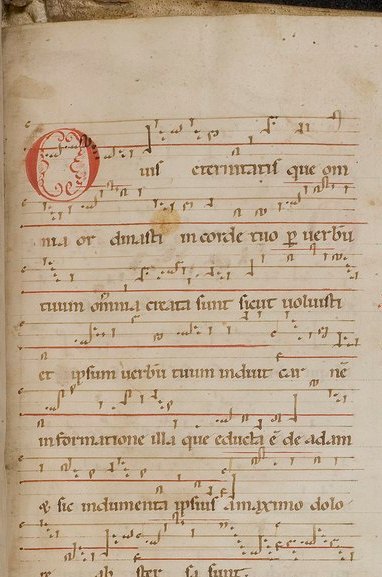
The nuns at Disibodenberg — where Hildegard lived as a young woman and was elected their mother superior — as well as at Rupertsberg and Eisenberg — the monasteries that she founded — met several times a day for sung prayer, following the daily cycle. Early morning before dawn, at dawn, at midday, and at sunset were the major prayer moments, plus three other “small hours” which helped regulate the day.
They were singing and chanting the regular repertoire of monodic hymns, antiphons, and psalms prescribed in the Benedictine rule, adopting the centuries-old melodies that had been standardized some time before. Hildegard, however, decided to modify the repertoire, especially adding new compositions.
While this practice was relatively common in large monasteries of the twelfth century, the quality of the additions she made is stunning. Many have recognized as much in recent decades, as witnessed by a veritable explosion of recordings of her music.
Some scholars have questioned the authorship of the Hildegardian repertoire; the same issue has been raised regarding the magnificent paintings depicting her visions, especially in the main manuscript of her first opus, Sci Vias Domini (Know the ways of the Lord).
But these questions are ill-posed, meaning that in her cultural context the contribution of more than one person to works of art is a non-issue. In a community of nuns or monks, especially, a sort of communal authorship is to be assumed, unless otherwise proven.
It is really unimportant whether the Hildegardian melodies were created by Hildegard on her own or with the help of others. What matters is that they reflect her theology and spirituality in very deep ways, in an amazing consonance between text and music.
A group of scholars correctly states that Hildegard’s music is widely considered to be original, idiosyncratic even. The Latin texts, which are rhapsodic and sometimes elliptical, are closely aligned with an ornate musical style that extends the boundaries of contemporary practice. *
Perhaps the most obvious aspects of Hildegard’s musical originality consist in her regular use of the interval of fifth — quite rare in the regular repertoire — which gives a sense of delight or even elation to the listeners, and the regular use of melismas which confer on her music a mysterious yet attractive quality.
Besides the ambience that her compositions create, one also needs to be aware that she employed music as a rhetorical tool, that is, as a means to convey her convictions about viriditas and everything else.
Take, for example, the responsory O Nobilissima Viriditas (O Most Noble Greenness), or the song to Mary O Viridissima Virga (O Most Green Branch) in which the Mother of the Lord is described in ways that, while starting from well-honed metaphors — Mary as a flower, Jesus as a fruit — become frankly intense and even erotic.
Spices, balsams, fragrances. The warmth of the sun on the skin. The wind gently blowing in the branches, the flowers appearing on them, and the birds nesting. Mary is compared to a healthy tree, and yet she has the sexual body of a woman, and yet she is a virgin — to Hildegard was very important to stay away from men, sexually speaking, even though she writes openly about sex in her medical works.
Each of her pieces is worth, of course, detailed attention. The many recorded interpretations of her music that are available do not always do justice to what she intended. Often they reflect our contemporary taste, with the addition of instruments and rhythms that is seldom justified. However, the healing qualities of her melodies are so strong that they have surpassed these many centuries and can be clearly perceived even today.
*Quote from Nathaniel M. Campbell, Beverly R. Lomer, and Xenia Sandstrom-McGuire, The Symphonia and Ordo Virtutum of Hildegard von Bingen at https://www.hildegard-society.org/p/music.html
Banner Image: Choirs of angels singing praises: “All Beings Celebrate Creation,” from Hildegard of Bingen, Scivias.
Queries for Contemplation
What happens to you when you listen to Hildegard’s music?
Related Readings by Matthew Fox
Hildegard of Bingen, A Saint for Our Times: Unleashing Her Power in the 21st Century
Creativity: Where the Divine and Human Meet
Hildegard of Bingen’s Book of Divine Works: With Letters & Songs
The Reinvention of Work: A New Vision of Livelihood For Our Time
Illuminations of Hildegard of Bingen
WHEE! We, wee All the Way Home: A Guide to Sensual Prophetic Spirituality
Gabriele Uhlein, Meditations with Hildegard of Bingen, Preface by Matthew Fox.


7 thoughts on “Hildegard as a Musician”
The transcendent music of Hildegard is a balm to the soul. It brings a grounding presence while simultaneously connecting us with the cosmos—a sense of coherence with the Divine within our humanity.
In meditation, I have found her music to be a sacred tool for healing the soul and, through the light of awareness, for restoring the balance and harmony of body and soul. It can become an offering of awareness to the living energy within our cells, inviting us toward a deeper sense of wholeness.
Hildegard used mandalas to express the profound relationship between God, humanity, and all of creation. To me, it is a beautiful exercise to imagine the mandala that we are being drawn into through these heavenly vibrations—a mandala of interconnectedness, balance, and wholeness.
Hildegard left us a beautiful map, along with an array of heavenly “tools,” to empower us to bring mind, body, and soul into greater harmony and holistic restoration.
Well said. I feel mysticism and mystery and calmness.
I feel the Beauty, Joy, and Worship of Feminine human voices to Our Living Mother~Father Source~Co-Creator… in the Sacred Process of the Eternal Present Moment….
Off topic perhaps, but I think it’s probably only in a country where the myth of individualism is honored above the work of community that people criticize a work of art developed in community rather than by a single person. Questioning Hildegard’s authorship of works attributed to her are also likely to have come from a misogynist cultural approach too. I see the same kind of misogynistic complaints about my two plays involving architect Mary Jane Colter from men (only men) who try to convince others than Colter could not have designed the buildings she did. It takes a weak soul to have to tear down women’s accomplishments in order to feel manly. To me, both artists (Hildegard and Colter) created art that is intensely female–Hildegard per the womb of creation she generates in her focus on “greenness” and Colter in her warm, inviting, buildings that draw visitors in and once inside embrace them with warmth. Isn’t it finally time to allow women to create in their own ways and to honor their unique contributions to culture and religion? Must men be so weak that they have to question whether women actually have the capacity to create amazing, innovative things? Thanks for listening to my rant and thanks to the many men reading this who value the creations of women.
I am transported to another world, a heavenly realm.
Oh my goodness when I listen to Hildegard’s music I am transported, transcendent! I seriously can’t get enough. I have been an early music aficionado forever, but I never went much earlier than Telemann. I nearly went to the New England Conservatory for early baroque flute performance but I decided I wasn’t good enough, and didn’t want to practice 8 hours a day to become good enough. But my passion for early music remains. Thank you for sharing these pieces, I look forward to marinating in them and discovering their depths.
The more I learn about Hildegard the deeper I fall in love with her. What a magnificent human.
When I listen and read the text of O Viridissima Virga, a deep sense of rightness, the verdant peace of the green woods, and an uplifted spirit come into my heart. I’ve listened to her works before, but today’s DM helped me seek again, and find an unexpected purity and ineffable sense of God. Thank you for turning our hearts and minds to this source of praise!
Thank you, too, commenters who shared their perspectives ~ It is good to be together in the Lord.