
Before the 20th century, the Gospel of Mark was seen mainly as a summary of the Gospel of Matthew. Contemporary scholars instead believe it to be the First Gospel in chronological order — written about the year 70 AD — from which both Matthew and Luke derived their storyline. The question of the originality of Mark comes then powerfully onto the stage.
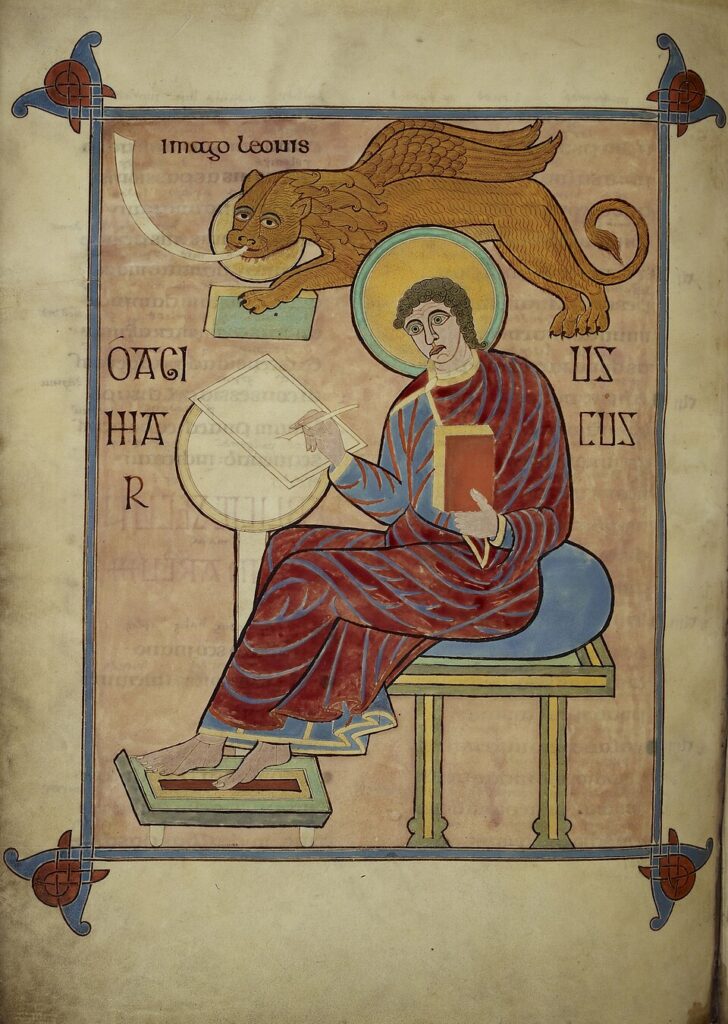
Once I witnessed pure marvel on the face of one of my students while she exclaimed: But… but… then Mark constructed the narrative of the life of Jesus as he liked… we don’t even know how much he made up! And the other [evangelists] just followed him! To which I answered: Yep! Only with the addition that “Mark” could have been a woman — of which I may say something another time.
I fell in love with the Gospel of Mark many years ago, before I knew I was going to become a theologian — or maybe this Gospel played a part in that choice! A Paulist nun suggested that I read a small booklet of meditations and poetry about it. I was hooked. I keep that booklet to this day, even though I have progressed a lot in my studies and understanding of this literary gem disguised as a simple story.
The notion that this Gospel could yield the best information about what Jesus actually did and said, because of its chronological closeness to the events, must be taken with a grain of salt. Scholars suppose that there were other documents circulating at that same time which reported the sayings of Jesus, many of which did not make it into the Gospel of Mark, and were used instead by Matthew and Luke. In any case, the Markan Gospel is not by any means a simple repository of memories about Jesus. It’s a full-fledged interpretation of him.
The storyline is that of a man coming out of nowhere who has a potent mystical experience and immediately starts fighting with the demons, first inside himself and then all around him. The world as depicted in the Gospel of Mark is indeed the abode of myriads of demons who keep people enslaved in their minds and bodies; Jesus is the one who has come to destroy the power of such evil fetters. He fights specifically against a mummified religion and for the inclusion of all at the table, which means that his message iis highly political yet also much more than political.
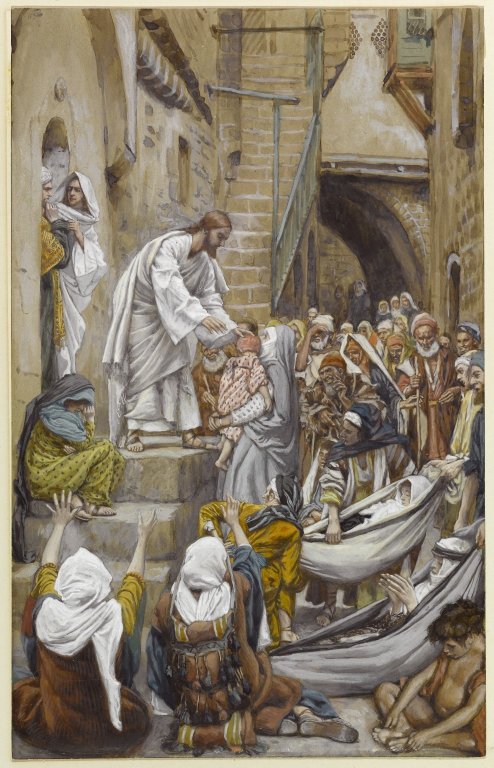
His fame grows very fast, and so do his followers, but soon the powers-that-be decide that he must be eliminated. The second half of the drama depicts Jesus’s awareness of the impending tragedy and the corresponding numbness of his followers. His teaching shifts from the joyous growing of the kingdom of God to the community that will remain after his death. Here belong stories such as that of the quarrel about hierarchy among the closest disciples, to which Jesus answers by placing the most vulnerable — a child — in the center of the circle.
Finally, the Gospel of Mark presents a quite detailed narrative of the Passion of Jesus, whose length can only be explained as a result of trauma. Indeed, the whole Gospel of Mark can be seen as emerging out of the traumatic experience of the execution of Jesus, that is, as a tool for healing through remembrance and the weaving of relationships. At the end — very strangely when compared to the other Gospels— the story of the empty tomb is not the climax of the narrative.
(to be continued)
Banner Image: Christ chooses the twelve apostles. Passeri. In the Bowyer Bible (1791-1795) in Bolton Museum, England. Print 3638. Wikimedia Commons.
Queries for Contemplation
Several scholars have remarked that the Gospel of Mark is strangely postmodern in its outlook. What are the code words in this meditation that hint at such interpretation? Have you ever read the Gospel of Mark in this way?
Related Readings by Matthew Fox
Charles Burack, ed., Matthew Fox: Essential Writings on Creation Spirituality
Original Blessing: A Primer in Creation Spirituality
The Beloved Will Guide You: St. John of the Cross and the Triple Dark Night of Our Times
Matthew Fox and Bishop Marc Andrus, Stations of the Cosmic Christ
A Spirituality Named Compassion: Uniting Mystical Awareness with Social Justice
Prayer: A Radical Response to Life


4 thoughts on “The Gospel of Mark, part 1”
I recently began my deeper exploration of Mark, and the first thing that struck me was that it doesn’t open with Jesus. It opens with “As it is written in Isaiah the prophet…”
Then I learned that the quotation isn’t only Isaiah. Part of it comes from Malachi and Exodus. So even the beginning is borrowed voices woven together.
Your line that Mark is “not a simple repository of memories” but “a full-fledged interpretation” helped me understand why that might matter. By putting the prophets’ words first, Mark seems to be telling us how to see John and Jesus before they even appear. He’s shaping the story, not just recording it.
I’ve also been sitting with the idea that the ending sends us back to Galilee, back to the beginning, to read again as the disciple who doesn’t run. That one feels personal. I’m learning how to stay.
I’m new to reading scripture this way and I’m curious how it will inform the rest of my reading. Thank you for this. It is opening my eyes further.
Mark is my favourite gospel. In the first chapter when he says Jesus goes out into the wilderness, he says “he was with the wild animals.” The particular Greek word “with” Mark uses, means “close, affectionate, association with”. I love that!! Noticeably, both Luke and Matthew scrub that out when they tell the wilderness story, can’t have Christ loving all of creation (especially animals who we want to diminish and use how we like), love for humans only. Mark kept the “with”. That makes me think Mark was someone who liked truth and kindness, no matter what. I like that, and I like him.
Slightly off topic – I’m curious what version of the bible most read or recommend. There are many versions. Or does it matter?
I’ve never read the gospel of Mark and I don’t really understand what postmodern means despite having looked it up several times over the years. So I’m gonna sit this one out.