
After writing yesterday’s DM, a question arose in me: Awareness of what? Awareness of the tragedy that is playing out under our eyes? How is that going to help?

Having meditated upon this question, I can now say that the awareness of tragedy is indeed an important part of the answer that the world needs.
“Tragedy” does not simply mean “something very bad” but a situation that feels doomed when lived from the inside. Whatever route is attempted or imagined, the characters of a tragedy feel forced to go back to the same knot that will be unraveled eventually only by someone’s demise.
An important element of tragedy is that each of the characters involved have good reasons to hold the position they do, from which they cannot even imagine moving. It is part and parcel of their identity to be in that position.
Seen from the outside, the situation may look serious, but not desperate. If only this character could make such and such concession, and the other characters could allow for this and that to happen… But tragedy is a strong collective archetype that — when it takes hold of a group of people — it’s very hard to budge.
Surely, there is also evil involved. Evil likes tragic situations and taking advantage of them. Evil people who are keen on taking advantage of others will exploit any weakness and lead their group toward destruction. But that is only the last act.
In a tragedy, before the final catastrophe, there are mostly frightened people who try to think really hard about how to get out of the trap, while fear blocks their thinking and makes them blind to reality and to possibility. That’s why the help from compassionate people who are outsiders can be very valuable.
The amount of blindness that has been historically involved in the conflict between Israel and Palestine is staggering. Many Zionists earnestly believed in the early 1900s that they were going to create a new society free from persecutions and oppression and, in the process, they would also bring technological advancements to Palestine. Most of them had not a clue about the colonial and racist nature of the project. Many Palestinians in the 1930s approved the alliance between the Grand Mufti of Jerusalem and Hitler, in the stated hope to get clear of the Jewish European settlers. They did not see at all that ignoring the humanity of the Jews was a serious moral failure.
Things went on with more and more blindness, until some enlightened (not perfect) individuals became aware of the tragic nature of the situation and the possibility of escaping it. The Oslo agreements of the 1990s were not ideal, but they represented a real path forward. The forces of blindness, however, prevailed and, to this day, they keep building up the tragedy.

Recognizing when the archetype of the tragedy is at work is the first step to dissolve the hold that the archetype itself has on people’s minds. Obviously a psychological view of the issue of Israel/Palestine will not substitute for political analysis or for active relief of the victims, but the ability to embrace all the decent people involved in a tragedy, and all their motivations, is the true mark of the kind of spirituality that we want to bring into the world.
Today, as always, our job as moral and spiritual people is that of taking sides against injustice, but that should not mean taking sides within a tragedy, i.e. being absorbed by it. On the contrary, we need to employ a good portion of our mental energy to stay away from the archetype of the tragedy — this is true for our individual lives, but it applies as well to social groups and nations.
See Matthew Fox, Sins of the Spirit, Blessings of the Flesh: Transforming Evil in Soul and Society
See also Fox, Trump & The MAGA Movement as Anti-Christ
And Fox, The Tao of Thomas Aquinas: Fierce Wisdom for Hard Times
And Fox, Meister Eckhart: A Mystic-Warrior For Our Time
And Fox, A Way to God: Thomas Merton’s Creation Spirituality Journey
And Fox, Original Blessing: A Primer in Creation Spirituality
Banner Image: Palestinians inspect the damage following an Israeli airstrike on the El-Remal area in Gaza City on October 9, 2023: the beginning of a continuous Israeli bombardment that has leveled most of the city, killing more than 63,000 men, women, and children, while blocked food shipments create engineered famine. Photo by Naaman Omar apaimages, Wikimedia Commons.
Queries for Contemplation
Are you able to embrace the opposite poles of a tragic situation?
Related Readings by Matthew Fox

Sins of the Spirit, Blessings of the Flesh: Transforming Evil in Soul and Society
Visionary theologian and best-selling author Matthew Fox offers a new theology of evil that fundamentally changes the traditional perception of good and evil and points the way to a more enlightened treatment of ourselves, one another, and all of nature. In comparing the Eastern tradition of the 7 chakras to the Western tradition of the 7 capital sins, Fox allows us to think creatively about our capacity for personal and institutional evil and what we can do about them.
“A scholarly masterpiece embodying a better vision and depth of perception far beyond the grasp of any one single science. A breath-taking analysis.” — Diarmuid O’Murchu, author of Quantum Theology: Spiritual Implications of the New Physics

Trump & The MAGA Movement as Anti-Christ: A Handbook for the 2024 Election
Matthew Fox tells us that he had always shied away from using the term “Anti-Christ” because it was so often used to spread control and fear. However, given today’s rise of authoritarianism and forces of democracide, ecocide, and christofascism, he turns the tables in this book employing the archetype for the cause of justice, democracy, and a renewed Earth and humanity.
From the Foreword: If there was ever a time, a moment, for examining the archetype of the Antichrist, it is now…Read this book with an open mind. Good and evil are real forces in our world. ~~ Caroline Myss, author of Anatomy of the Spirit and Conversations with the Divine.
For immediate access to Trump & The MAGA Movement as Anti-Christ: A Handbook for the 2024 Election, order the e-book with 10 full-color prints from Amazon HERE.
To get a print-on-demand paperback copy with black & white images, order from Amazon HERE or IUniverse HERE.
To receive a limited-edition, full-color paperback copy, order from MatthewFox.org HERE.
Order the audiobook HERE for immediate download.

The Tao of Thomas Aquinas: Fierce Wisdom for Hard Times
A stunning spiritual handbook drawn from the substantive teachings of Aquinas’ mystical/prophetic genius, offering a sublime roadmap for spirituality and action.
Foreword by Ilia Delio.
“What a wonderful book! Only Matt Fox could bring to life the wisdom and brilliance of Aquinas with so much creativity. The Tao of Thomas Aquinas is a masterpiece.”
–Caroline Myss, author of Anatomy of the Spirit
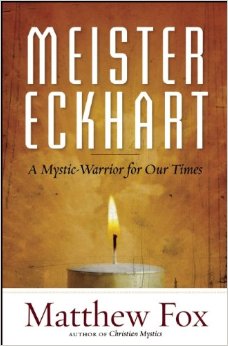
Meister Eckhart: A Mystic-Warrior For Our Time
While Matthew Fox recognizes that Meister Eckhart has influenced thinkers throughout history, he also wants to introduce Eckhart to today’s activists addressing contemporary crises. Toward that end, Fox creates dialogues between Eckhart and Carl Jung, Thich Nhat Hanh, Rabbi Heschel, Black Elk, Karl Marx, Rumi, Adrienne Rich, Dorothee Soelle, David Korten, Anita Roddick, Lily Yeh, M.C. Richards, and many others.
“Matthew Fox is perhaps the greatest writer on Meister Eckhart that has ever existed. (He) has successfully bridged a gap between Eckhart as a shamanistic personality and Eckhart as a post-modern mentor to the Inter-faith movement, to reveal just how cosmic Eckhart really is, and how remarkably relevant to today’s religious crisis! ” — Steven Herrmann, Author of Spiritual Democracy: The Wisdom of Early American Visionaries for the Journey Forward

A Way to God: Thomas Merton’s Creation Spirituality Journey
In A Way to God, Fox explores Merton’s pioneering work in interfaith, his essential teachings on mixing contemplation and action, and how the vision of Meister Eckhart profoundly influenced Merton in what Fox calls his Creation Spirituality journey.
“This wise and marvelous book will profoundly inspire all those who love Merton and want to know him more deeply.” — Andrew Harvey, author of The Hope: A Guide to Sacred Activism

Original Blessing: A Primer in Creation Spirituality
Matthew Fox lays out a whole new direction for Christianity—a direction that is in fact very ancient and very grounded in Jewish thinking (the fact that Jesus was a Jew is often neglected by Christian theology): the Four Paths of Creation Spirituality, the Vias Positiva, Negativa, Creativa and Transformativa in an extended and deeply developed way.
“Original Blessing makes available to the Christian world and to the human community a radical cure for all dark and derogatory views of the natural world wherever these may have originated.” –Thomas Berry, author, The Dream of the Earth; The Great Work; co-author, The Universe Story


5 thoughts on “Awareness of Tragedy”
Embracing the shadow on a communal level, to not be absorbed by the archetype of tragedy, has always been very challenging for humanity, and it’s intimately related to every human being responsibly/consciously integrating their own personal/communal shadow on his/her own unique spiritual journey, which is also very challenging but potentially possible, as the mystics/prophets/saints have shown Us, with Our SOULS’ SPIRIT of DIVINE LOVE~WISDOM healing, guiding, transforming Us to experiencing LOVING DIVERSE ONENESS — COMPASSIONATE CHRIST-BUDDHA CONSCIOUSNESS — in Our Human Evolution….
Thank you, Gianluiggi, for stressing the importance of “awareness of the tragedy” unfolding daily in front of our eyes, and of the fact that “the amount of blindness that has been historically involved in the conflict between Israel and Palestine is staggering.”
This blindness includes the denial of the basic similarities between the history of an America ethically reaching bottom in its hubris to be great again, and that of its Middle Eastern satellite where every moral compass has been lost for quite a while: 1) both have first been claimed as “Promised Land,” 2) both have been established through a land grab, and 3) both have genocidal blood on their hands. Yet both swear on the same Bible in which “the Lord said: What have you done? The voice of your brother’s blood is crying to me from the ground.” [Gen. 4:10]. What else other than blindness could result from “an eye for an eye”?
My friend R. explained to me my own writing: “I like your discussion of the archetype of tragedy, how it takes the vision/insight of a compassionate person who stands outside the tragedy to indicate an opening or way forward, true on individual and corporate levels.”
In other words, I am trying to say that sometimes human conflicts take the archetypal form of a tragedy, that is important to recognize that this is happening because it fixes the situation and makes it unsolvable (this happens to individuals in their personal lives as well) and that only somebody from the outside who can see the tragedic pattern unfolding may offer help. This individual or individuals though, must not be absorbed into the tragedic pattern. They must recognize it and feel it emphatically, but they must stay out of it psychologically, in order to be able to help.
I remind myself that Christ does not take sides except against injustice, and we must strive to do the same. It requires moving back from entanglement in the horrors, while still recognizing and naming them as the corporate sin and evil that they are. It requires understanding that there are reasons for people’s and group’s actions, even when we find them despicable. To demonize them just puts us in the same attitude of negativity and just perpetuates the depravity, as we are now part of it. To understand is not to condone, and to have compassion on those doing harm does not mean agreement with them. There is a lot written in the bible about forgiveness and loving those who persecute you—because it is so hard to do. But I must acknowledge that they are God’s beloved, just as I am, and love is the only power strong enough to fuel my activism, though it may contain much holy anger. Somewhere I read that this is the day to honor the Navajo code talkers from WW2. Here is an instance of transformation despite unrelenting persecution and abuse of our Native Americans–these men served a cause greater than themselves and did it willingly, despite the risks.
Thank you so much! I’d been struggling as I overheard someone I greatly admire say, “I don’t take sides,” referring to Gaza. (Inside I was screaming – don’t take sides? What about when children are starving?). But I was not in the conversation, and saying, “I take sides. Especially when there are huge power differentials,” would have achieved little. I decided to ask, “what does it mean to you, to not take sides,” and to explore it – should I have the opportunity.
Finding the right distance is often the key–close enough to allow myself to be moved, as much as possible- to act, but not so close as to get lost and overwhelmed and unable to act.
Personally it’s always a challenge to back up so as not to judge my neighbour and to get close enough to ask useful questions for accountability and action. Distance and denial is used as a cop out. Considering the financial support and supply of weaponry, Canada and the US share in the responsibility to those children and we need to take that seriously!
Thank you so much for your posts and help.