
I am waking up on the next day after elections in the State of Israel. President Herzog may still decide to ask his friend Bibi, the famous war criminal, to head the new government. It would not be surprising, given that Herzog himself has offered support to the genocide in Gaza, even though he tried to hide it under a veneer of respectability.
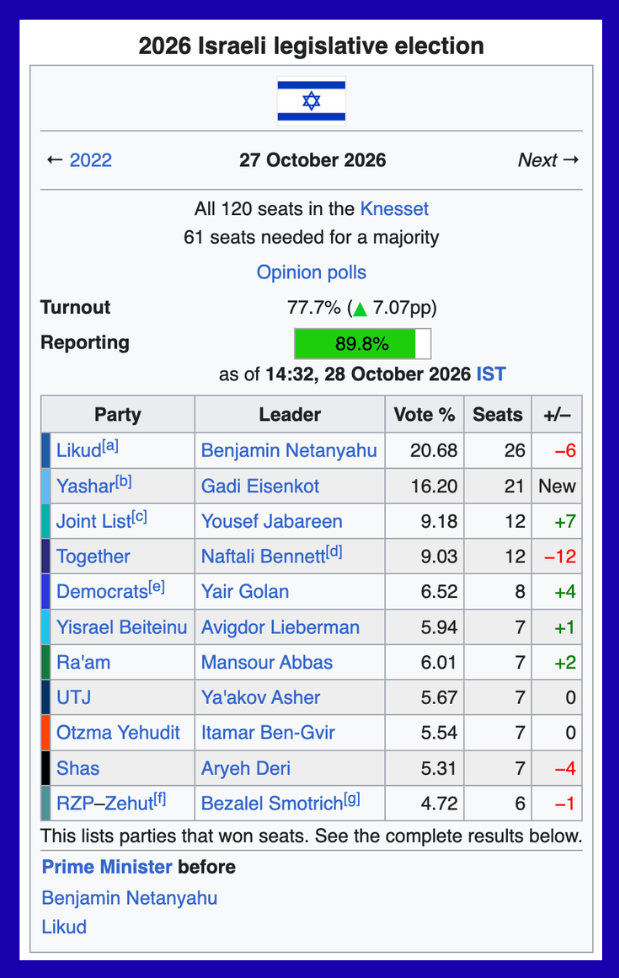
At the same time, a party that was started just one year ago challenged the murderous status quo and was voted in by half of the Jewish population of Israel. Its leader, Gadi Eisenkot, is a military man and a nationalist. Nonetheless, he might be rational and humane. Nowadays, it would be a wonderful surprise.
What the world needs — besides the ultimate triumph of spiritual democracy — is people who help us get out of the current frenzy of cruelty, disdain for human life, and lack of moral decency.
Eisenkot now controls 47 seats in parliament; the so-called Arab parties hold 19. Together they could easily overcome the 54 seats of the Likud and allies — the bloc mainly responsible for the genocide — and form a new government. Yet deep-seated suspicions, great differences in political platforms, and Herzog’s weight in the process may prevent such a desirable outcome.
Eisenkot does not support the two-state solution. On the surface, therefore, he is not good news to many who support the rightful desire of Palestinians to live in their own nation. I doubt, however, that somebody saying that they do support the two-state solution would have achieved any measure of success in these elections.
Fundamentally, Eisenkot and his party Yashar — the name means “honesty and truthfulness” — want the State of Israel to thrive as a liberal democratic state, instead of becoming a war-mongering superpower. How can this mean essentially anything else than the continued oppression of Palestinians, keeping them encaged in military-controlled areas with no real political rights and with a survival economy at best?
I find, however, between the lines in Eisenkot’s speeches, a hidden option which would upset everybody, and yet might be the only viable roadmap: the gradual inclusion of all Palestinians within the democratic process, with the final — yet unspeakable — aim to make citizens of all of them.
This solution would not give Palestinians a state. Israel, with its flag, will remain and control the territory “from the river to the sea” through progressive annexations which, in the long run, will be recognized internationally. The right of return for Palestinians will not become a reality. The state of Israel will become bicultural and bilingual, but with the Palestinian-born population soon overriding numerically the Israeli-born population.
Eisenkot presently advocates the immigration of millions of Jews to Israel. This seems to me an indication that he is thinking about balancing numerically the two components of the future state.
Is this a utopia or a dystopia? Maybe a realistic hope? The very fact that half of the Jewish population of Israel backed Eisenkot means something. Half of them are tired of war and massacres. They are gasping for something different.
We are confronted with enormous suffering and trauma spanning generations. It is very painful to accept — as many Jewish cultural figures have done around the world — that the heirs of the victims of Nazism have developed a Nazi mentality. That is the other half, the dark side of Israel today. Will Israel/Palestine become a laboratory of reconciliation and healing, or will it develop into an even more rotten and sad place?
Banner Image: 2026 election polling stations, Israel. Photo by Nizzan Cohen on Wikimedia Commons.
Queries for Contemplation
What feelings are evoked in you by the situation in Israel/Palestine? How are these feelings helpful to you, or could become helpful to you?
Related Readings by Matthew Fox
Adam Bucko and Matthew Fox, Occupy Spirituality: A Radical Vision for a New Generation
Creation Spirituality: Liberating Gifts for the Peoples of the Earth
TRUMP AND THE MAGA MOVEMENT AS ANTICHRIST: Recognizing the Archetype of Evil in Our Time
Sins of the Spirit, Blessings of the Flesh: Transforming Evil in Soul and Society
The Tao of Thomas Aquinas: Fierce Wisdom for Hard Times
One River, Many Wells: Wisdom Springing from Global Faiths
Prayer: A Radical Response to Life
The Hidden Spirituality of Men: Ten Metaphors to Awaken the Sacred Masculine
A Spirituality Named Compassion: Uniting Mystical Awareness with Social Justice

